

Innovative architecture gives rise to schools of the future
Creative thinking solves conundrum of limited space, urgent need for student places










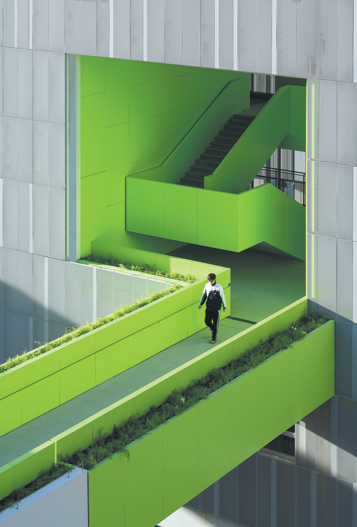
Theaters, sports halls, and the swimming pool are positioned along the city-facing side with independent lobbies, allowing the spaces to be safely opened to the public on weekends and in the evenings, he said.
"It was the first time in Shenzhen a high school implemented a fully operable controlled open model," said former principal Wang Dejiu.
The design aligns with a core goal of the new campus action plan to make schools centers of community life.
For Wang, the new space has been transformative. "The students are no longer isolated from the city, and they become observers of it," he said.
The complex layout encourages exploration, and the state-of-the-art facilities have enabled a shift to project-based learning and elective physical education modules.
"Space pushed the curriculum forward. That's something we could never achieve before," Wang stated.
Zhou expressed hope that this innovative philosophy and methodology will inspire more city managers and public administrators to engage with the "intense urban realities" of their own cities.
In her architectural philosophy, a school is never merely a vessel for education, but the physical embodiment of its ideals.
"Space and place should serve as a 'third teacher', alongside mentors and peers," she explained, adding that quality spaces nurture children and become their growth companions. "The campus itself is the best textbook for holistic education," she said.
She has observed how in innovative environments like the Hongling school, children get to blow off steam during breaks and return to class calmer and more focused.
Her team has successfully preserved a historical training center at Yucai High School, a site embodying local reform and opening-up legacy, and fought off pressure by keeping a grove of banyan trees considered low value at Renmin Primary School.
Zhou believes both of these achievements will help children better appreciate the history and nature of the place where they grew up.
For He Jianxiang, the greatest joy of building the Hongling school goes beyond professional acclaim and lies in the living pulse it now contains.
He said he has seen architecture actively participating in learning, as "teachers hold classes in courtyards, the library, even the playground".
"Anywhere on campus can become a classroom. Many parents say their children are reluctant to leave after school because it's so much fun inside," he said proudly.
He said the takeaway from the success of the school is that even under the most demanding constraints, architecture can transcend pure functionalism to return to a human scale and meet emotional needs.
"In a migrant city like Shenzhen, we hope to give the new generation a memorable, happy childhood and build a home for them," he said.
yangfeiyue@chinadaily.com.cn