


Innovative architecture gives rise to schools of the future
Creative thinking solves conundrum of limited space, urgent need for student places










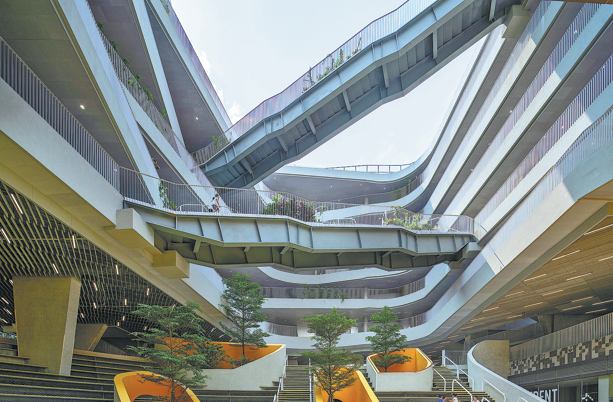
"It was like fitting three times the building mass on the same footprint," He explained. Despite the challenge, his team set a red line for themselves — the building height could not exceed 24 meters.
This was a crucial self-imposed limit, as surpassing it would require meeting national fire codes such as enclosed stairwells with lobbies, which He believed would severely hinder the children's freedom of movement and interaction.
Faced with the dual pressures of extreme density and rigid regulations, the conventional approach would have been to use standardized, repetitive, rectangular units to create a building.
He rejected this shortcut. "It's a fast way to design, but it makes for very dull cities and buildings," he said.
At the time, his own child was in kindergarten, giving him a personal perspective on the challenge. "We wanted a place where children could explore freely," he said.
He found inspiration from local terraced geographical features and conceived two valley-like sunken courtyards from which arched floor slabs, ramps and corridors "organically grew".
Yet, compressing the building mass meant an incredibly high density, which clashed with another national standard that every classroom must receive at least one hour of direct sunlight on the winter solstice.
"This consumed a huge amount of our effort," He said, pointing to the intricately intertwined corridors and buildings. "What you see as these 'twisting' forms are largely the result of precise calibration to ensure even the lowest floors meet the code."
Now, the hexagonal-shaped classrooms perfectly support the school's project-based teaching model, while the partition between two classrooms can be opened, allowing classes to split or merge. Desks can be reconfigured for various teaching styles.
The sloped, curved corridors have become the children's favorites, as they can joyfully slide down on their knees. The sunken courtyards host the library and art rooms, creating a seamless flow between inside and outside, allowing lessons to spill naturally into the open air, the architect said.
"Last time I brought architects from Belgium, we happened to see children drawing the school's spaces. It seemed that the entire campus was their first project for inquiry," He said.





