

Innovative architecture gives rise to schools of the future
Creative thinking solves conundrum of limited space, urgent need for student places










A key obstacle was the traditional "turnkey project" model, where schools were designed and built with minimal input from the eventual users, she said. This left the needs of teachers and students, and the spatial ideals of architects, misaligned.
Zhou's solution was an alliance-exhibition mechanism, a hybrid of a "cluster design" practice and an open competition. "Whenever architecture faces a turning point, masters gather to propose new ideas — this is an alliance or cluster design," she explained.
She established academic committees to provide professional oversight from planning and selection to final review.
Crucially, this mechanism brought the users — the schools — into the process early and gave them deep involvement.
"Our biggest highlight is involving the school side from the very beginning of the design competition right through to implementation," she said. This stood in stark contrast to the turnkey model, where a principal might not see their school until being handed the keys.
Zhou also pioneered a collaborative working platform, where she brought all the departments together to deliberate from the start. Officials from planning, water services, fire safety, and other related parties sat down together to reach a consensus.
Riding this momentum, Zhou expanded the groundbreaking approach from Futian to Shenzhen's Longgang and Nanshan districts, giving rise to more than 100 proposals for 35 schools.
In March 2022, this evolution culminated in the "Nanshan one hundred schools renewal" action, targeting 143 aging kindergartens and schools in the district for innovative, low-cost renovations.
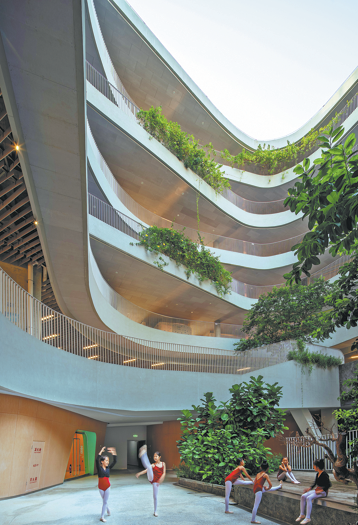
It transformed kindergartens into learning playgrounds where children can climb onto the roofs, and play and move freely on terraces. Once closed-off, crowded spaces were opened up by removing walls, allowing children to visit neighboring classes.
In early November, the Nanshan renewal action was awarded the urban innovation prize at the 3rd City For Humanity Awards hosted by the popular Beijing-based Sanlian Lifeweek magazine.
The jury praised it as a "contemporary interpretation of Shenzhen's 'dare to be the first' spirit", noting that through this massive creative renewal of campus spaces, the city's fearless innovative ethos is being subtly passed down to a new generation.
Shared resource
Older students have also benefited from Zhou's reforms, including those at Futian High School, about 5 kilometers from the Hongling school.
Architect Chen Chen vividly remembers the formidable task facing his team at the beginning of the building process. The new site for the school was on the last undeveloped plot in a hyper-dense district, squeezed by high-rises on three sides and a major road on the other.
The team's solution was a "porous campus" strategy, in which they lifted the 400-meter running track onto a platform, carved light wells into the deep podium, and threaded aerial walkways, dubbed "The Loop", through the complex. This "multi-ground system" created a vertical tapestry of courtyards, roof gardens, and interconnected social spaces.
The most groundbreaking aspect, however, was how the school engaged with the city.
The Futian school was designed to be a shared civic resource, with a dual-entry system that separates student and "community circulation", Chen said.