
The China Story
at your Fingertips
OPEN

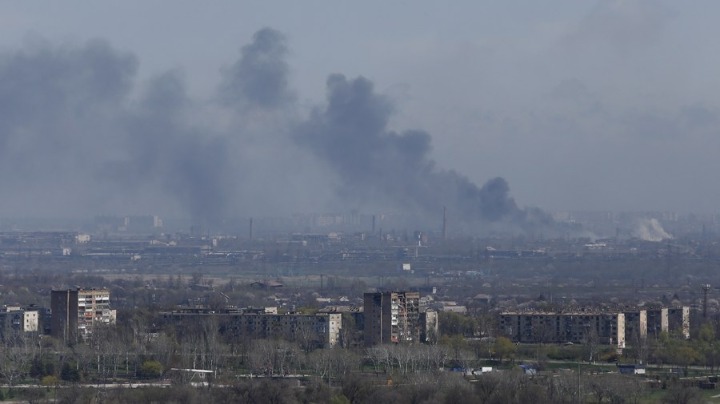
Russia's President Vladimir Putin says his country will continue its yearlong "special military operation" in Ukraine, and he accused the US-led NATO alliance of fanning the flames.
Russia-Ukraine conflict would have cost world economy $1.6 trillion in 2022, according to a study published by the German Economic Institute.
UNITED NATIONS - A Chinese envoy on Tuesday warned that indiscriminate sanctions over the Ukraine conflict will bring about new humanitarian problems.
"The ever-escalating sweeping and indiscriminate sanctions have hit global energy, food, economics and trade, and financial markets, and will continue to do so, affecting the lives and livelihoods of the general public, and giving rise to new humanitarian problems," Dai Bing, China's deputy permanent representative to the United Nations, told a Security Council meeting on the humanitarian situation in Ukraine.
Developing countries, which make up the majority of the world, are not parties to this conflict, and should not be drawn into the confrontation and forced to suffer the consequences of geopolitical clashes and sparring among major powers, he said.
Right now, global food security is being seriously challenged, which warrants due attention. Sanctions and economic blockades will only artificially exacerbate food shortages and price distortions, further disrupt food production and food supply chain across the world, push up food prices, and put burdens on developing countries, he said.
"We call for enhanced international coordination to stabilize food supply and food prices, refrain from unjustified export restrictions, keep the market working in a stable manner, and ensure global food security."
The United Nations, the World Food Programme, the Food and Agriculture Organization, the World Trade Organization and other agencies should actively contribute to coordinating food production and trade among countries, and helping developing countries tide over the shocks, said Dai.
As the conflict in Ukraine is persisting, effectively protecting civilian lives and meeting their humanitarian needs is a must. China calls for respect for international humanitarian law to avoid civilian casualties, protect civilian facilities, provide safe passage for evacuation and humanitarian access, and ensure a continuous supply of basic necessities. Protection of vulnerable groups such as women and children must be strengthened, he said.
If the crisis continues and escalates, further damage is on its way, a situation not in the interests of any party. The most conclusive way toward a cease-fire to end hostilities is dialogue and negotiation, he said.
The international community should encourage and support continued direct negotiations between Russia and Ukraine until a positive outcome is achieved and peace is restored, he said.
Security is indivisible. Seeking absolute security by pitting one bloc against another is the recipe for insecurity. The United States, NATO and the EU should also engage in dialogue with Russia, accommodate the legitimate security concerns of all parties, and build a balanced, effective and sustainable regional security architecture. China will continue to work toward and play a constructive role in easing the situation and resolving the crisis, he said.



KYIV - Ukrainian President Volodymyr Zelensky said on Tuesday that he saw positive signals from the peace talks between Ukraine and Russia.
"The signals we hear from the negotiating platform can be called positive," Zelensky said in a video address published on his official Telegram channel.
At the same time, Zelensky said Ukraine is "aware of all the risks" and will trust only "concrete results".
Earlier Tuesday, Ukrainian and Russian delegations held their latest round of peace talks in Turkey's city of Istanbul, the fifth since Russia launched a special military operation in Ukraine on Feb 24.
Following the negotiations on Tuesday, David Arakhamia, a member of the Ukrainian delegation, said Kyiv has proposed signing a new international treaty on security guarantees in an attempt to end the conflict in Ukraine.

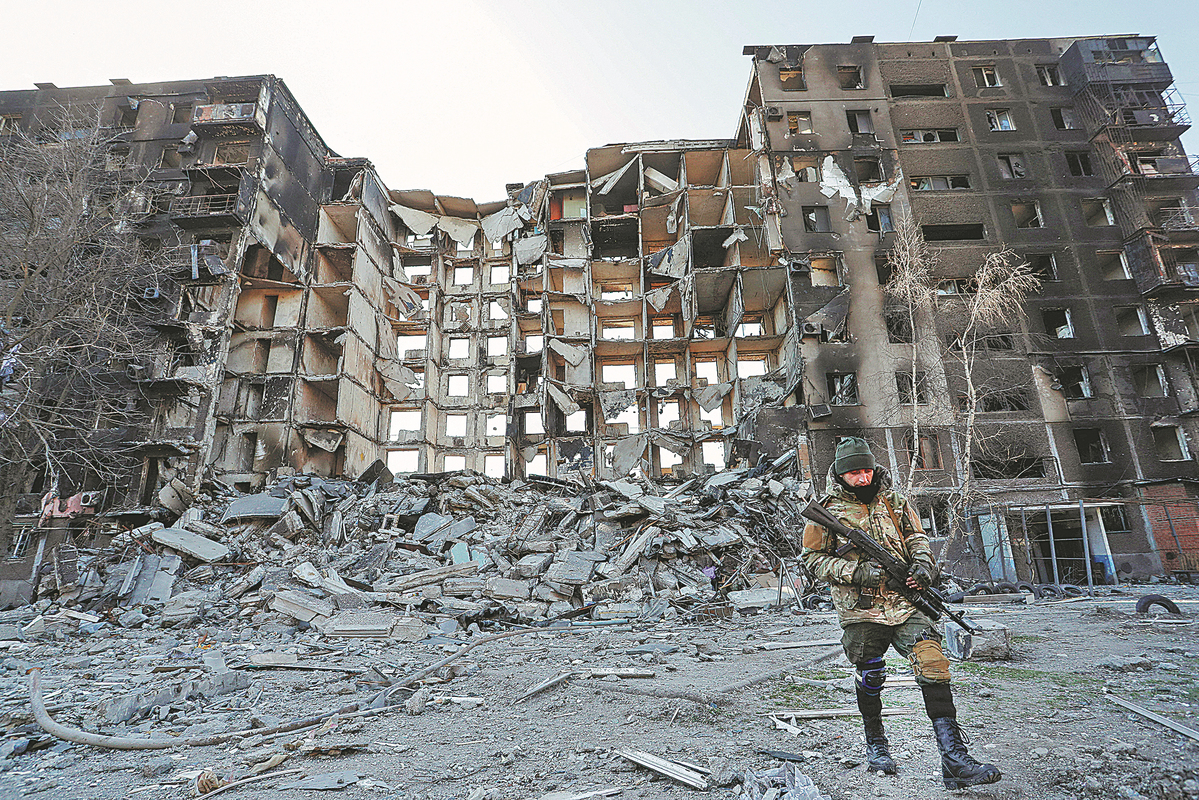
Double standards have become apparent in the contrasting ways Western countries have responded to the plight of refugees from within Europe and those from outside the region, say analysts who also see racism at work.
The United Nations' refugee agency said on Sunday that more than 3.8 million people had fled Ukraine over the past month, with women and children making up around 90 percent of them. Poland has taken in 2.2 million people and Romania has opened its borders to half a million of those fleeing the conflict.
The displays of compassion across Europe over the past month stand in marked contrast with the hostility shown toward refugees from the Middle East and Africa over the past few years.
Kathryn Mahoney, a spokesperson for the United Nations High Commissioner for Refugees, said recently that the agency welcomed the European Union's move to take in Ukrainian refugees among the member states, but stressed there was an urgent need for nations to respond similarly to other "serious "and "unresolved" displacements of people caused by humanitarian crises in Afghanistan, Syria, Ethiopia and elsewhere.
Ding Long, a professor at the Middle East Studies Institute of Shanghai International Studies University, said that the European countries' refugee policies have not been consistent. Their treatment of people of color from a range of origin countries exposes "double standards and even racism on the refugee issue".
He said that many European countries locked their doors to Syrian refugees in 2015 and to those fleeing Afghanistan last year. During the Ukraine crisis, they have ostensibly opened their doors to people fleeing the conflict. But in practice, European nations have also divided refugees into different groups and discriminated against them.
"Tens of thousands of people of African and Middle Eastern origin living in Ukraine face difficulties in leaving the country and entering EU countries," he said.
Sharp difference
Ding also points to the sharp difference in how Western media cover the Ukraine crisis compared with how they portray refugees from other regions. This makes clear the double standards and deep-rooted racial bias in these countries, he said.
In their reports, many Western journalists have focused on the appearance, skin color, race and religion of the Ukrainian refugees, and have made a comparison between them and refugees from the Middle East and North Africa.
"This shows that not all refugees are worthy of sympathy in the US-led West's perspective," he said. The unspoken implication is that the former are superior to the latter and have less reason to suffer from any plight.
Kelly Cobiella, an NBC News correspondent based in London, said in a video report: "To put it bluntly, these are not refugees from Syria, these are refugees from Ukraine…They're Christian, they're white, they're very similar (to us)."
On BFM TV, France's most-watched cable news channel, journalist Phillipe Corbe said: "We're not talking here about Syrians … We're talking about Europeans leaving in cars that look like ours to save their lives."
Zhang Lihua, a professor of the Department in International Relations and director of the Center for China-Europe Relations at Tsinghua University, said that while in the previous refugee crisis the European Union set a quota for member countries to take in refugees, some countries in Central and Eastern Europe firmly rejected the directive. However, this time, they have welcomed Ukrainian refugees.
She said that not only Ukrainian refugees in Europe need attention. Those who remain inside Ukraine and refugees in other conflict zones around the world also need the world's help.
Ding said that since the Ukraine crisis broke out, the US-led West has focused on the humanitarian damage caused by the conflict in Ukraine, but for too long it has turned a blind eye to the war, death and displacement in the Middle East and North Africa. To a large extent, the US-led West is behind these regional upheavals and refugee crises.
Xinhua contributed to this story.

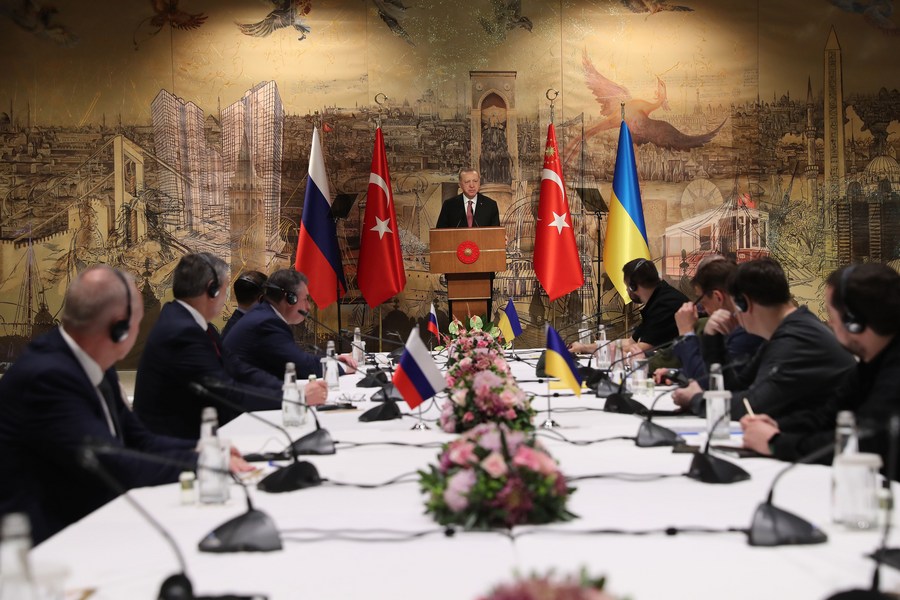
ISTANBUL - Russia and Ukraine have concluded their fresh round of face-to-face peace talks here on Tuesday, which lasted for about three hours.
Following the talks, the two sides made statements to reporters respectively. Ukrainian negotiators named several countries who could act as guarantors, while Russian delegates said Moscow would scale down its military operations in Ukraine.
David Arakhamia, a Ukrainian delegate, said that Kyiv wants to see several countries, such as Canada, Poland, Israel, and Turkey, as guarantors, which could provide international protection to Ukraine.
"If any other country wants to join they can do so," he said, noting that the agreement with Russia will be signed together with the guarantor countries.
Ukrainian presidential adviser and negotiator Mykhailo Podolyak told reporters that the results of Tuesday's meeting are sufficient for a meeting at the leaders' level.
Meanwhile, according to the Anadolu news agency, Vladimir Medinsky, head of the Russian delegation, said the talks in Istanbul were "constructive", and the presidents of the two countries may meet only when a draft of a peace treaty is approved.
Russian Deputy Defense Minister Alexander Fomin, who participated in the talks, pledged to drastically decrease military activities in Kyiv and the northern Ukrainian city of Chernihiv, to create the necessary conditions for dialogue.
Turkish Foreign Minister Mevlut Cavusoglu said Istanbul's meeting was the most meaningful progress since the start of the negotiations.
"We are extremely happy to see an increased rapprochement between the two sides at every stage," Cavusoglu added.

The US stock market surged Tuesday, as the progress in a new round of face-to-face talks between Russia and Ukraine boosted investor sentiment.

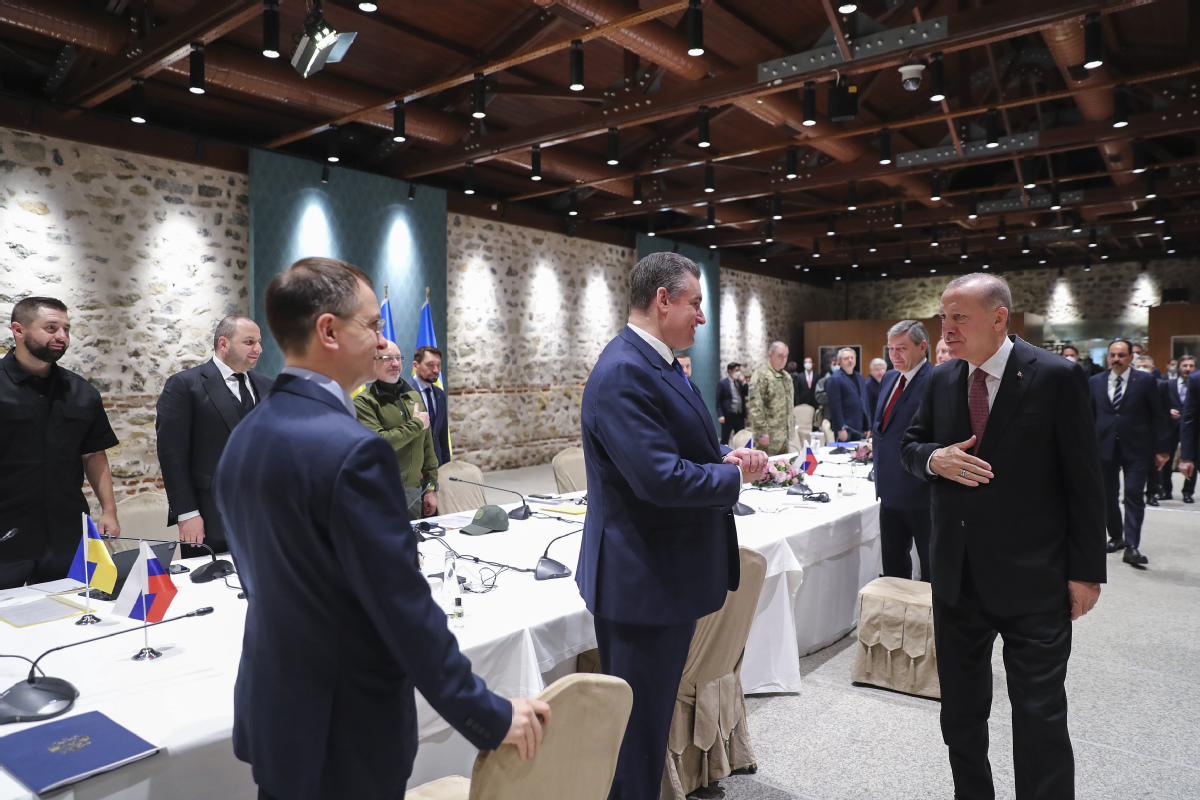
Russia's military announced on Tuesday it will "fundamentally" scale back operations near Kyiv, Ukraine's capital, and a northern city, as talks brought a possible deal to end the grinding war into view.
Russian Deputy Defense Minister Alexander Fomin said the move was meant to increase trust in the talks after several rounds of negotiations failed to halt what has devolved into a bloody campaign of attrition.
Fomin is leading the Russian delegation, which also includes negotiator Vladimir Medinsky, in talks with Ukraine, which began on Tuesday morning in Istanbul, Turkey. They are the first face-to-face talks between the two sides since March 7.
The Ukrainian delegation is being led by David Arakhamia, the head of Ukrainian President Volodymyr Zelensky's political party in parliament.
Fomin said Moscow had decided to "fundamentally … cut back military activity in the direction of Kyiv and Chernihiv" to "increase mutual trust and create conditions for further negotiations". He did not spell out what that would mean in practical terms.
Ukraine proposed adopting a neutral status with international guarantees to protect it from attack. Turkey, which hosted the talks, said the measures marked the most significant progress yet. Ukraine's military said it had noted withdrawals of some forces around Kyiv and Chernihiv.
Russian President Vladimir Putin has demanded the "demilitarization and denazification of the country," and that Ukraine adopt a neutral status and recognize that the Donbass region in the east and Crimea are no longer part of Ukraine.
Ahead of the talks, Zelensky said his country is prepared to declare its neutrality, as Moscow has demanded, and added that compromise might be possible over "the complex issue" of Donbass.
Mykhailo Podolyak, an adviser to Zelensky, said there are "intensive consultations going on regarding several important issues, the key among those is an agreement on international security guarantees for Ukraine."
Before the talks began the Kremlin denied Putin had considered using nuclear weapons in Ukraine.
During an interview with the TV channel PBS, Kremlin spokesman Dmitry Peskov said "no" when an interviewer asked whether Putin had suggested in an earlier statement that he would use nuclear weapons if a third party got involved in the conflict in Ukraine.
"I don't think so. But Putin was quite bold in saying: 'Do not interfere. If you do, we have all the possibilities to prevent that and to punish all those who are going to interfere'," Peskov said.
"No one is thinking about using… even about the idea of using nuclear weapons," he said.
The Kremlin said Russian billionaire Roman Abramovich is not an official member of the Russian negotiating team, but is present at the talks in Turkey to "enable certain contacts" between the two sides.
The Kremlin also dismissed reports that Abramovich, who played an early role in peace talks, had been poisoned, saying they were untrue and part of an "information war".
According to The Wall Street Journal and the investigative outlet Bellingcat, which cited people familiar with the matter, Abramovich and Ukrainian peace negotiators suffered symptoms of suspected poisoning earlier this month after a meeting in Kyiv.
Meanwhile, Ukrainian forces have taken Irpin, a gateway to Kyiv's northwest, from Russian control, Ukraine's Interior Minister Denys Monastyrsky said on Tuesday.
Russia's Ministry of Defence said on Tuesday it destroyed a large fuel base near the settlement of Klevan in Rivne Oblast in western Ukraine using high-precision cruise missiles.
Agencies contributed to this story.

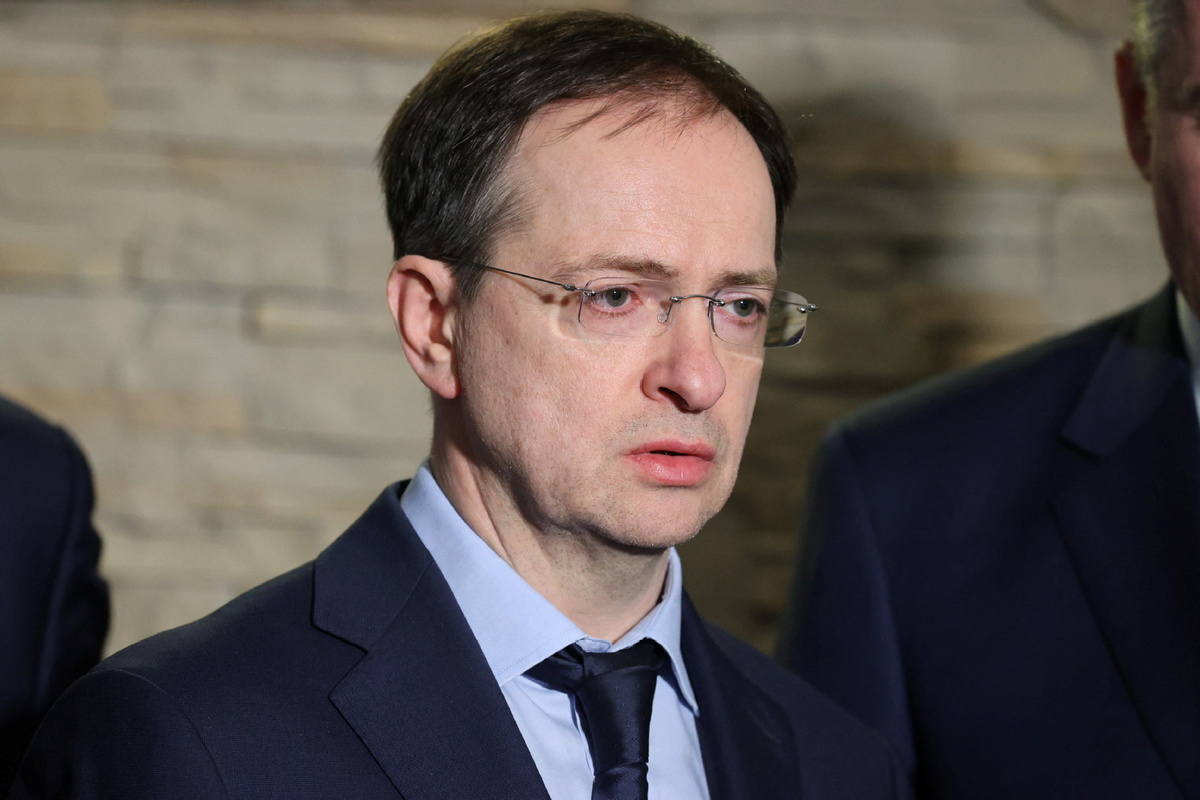
MOSCOW - Russian President Vladimir Putin and Ukrainian President Volodymyr Zelensky are likely to meet only after an agreement is ready for signing, Vladimir Medinsky, the head of Russia's negotiation team, said Tuesday.
Before the discussion of a possible meeting of the presidents, a treaty must be prepared and approved by the negotiators, and then endorsed by the foreign ministers, explained Medinsky, also an aide to the Russian president.
This will be not simple especially because the meeting could be a multilateral one with the participation of state guarantors of peace and security to Ukraine, he said after a new round of Moscow-Kiev talks in Istanbul, Turkey.

MOSCOW - The Russian Defense Ministry has decided to significantly reduce military activity in the Kyiv and Chernihiv directions, Russian Deputy Defense Minister Alexander Fomin announced Tuesday.
The decision was made to increase mutual trust between Russia and Ukraine and create the necessary conditions for further negotiations, Fomin said following the new round of Moscow-Kyiv peace talks in Istanbul, Turkey.
According to him, during Tuesday's negotiations, progress was made on the preparation for a treaty on the neutral and non-nuclear status of Ukraine as well as security guarantees to Ukraine.

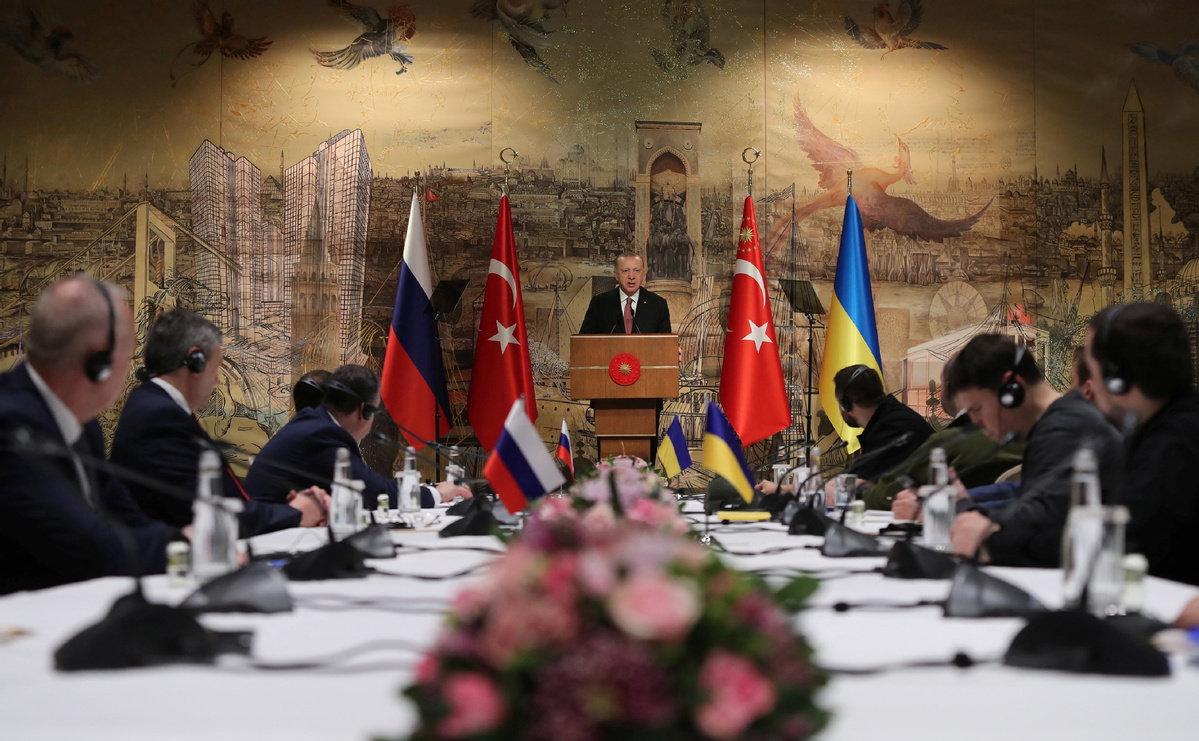
ISTANBUL - Russia and Ukraine have concluded their first day of fresh round of face-to-face peace talks here on Tuesday, which lasted for approximately three hours, according to media reports.
Ukraine's neutrality, its disarmament and security guarantees, de-Nazification and the removal of obstacles to Russian language usage in Ukraine, are among the topics on the table, local media reported ahead of the meeting.
The talks between Ukraine and Russia in the Turkish city of Istanbul are "difficult", Mykhailo Podolyak, a member of the Ukrainian delegation, said Tuesday.


ISTANBUL - Russia and Ukraine kicked off a fresh round of face-to-face peace talks here on Tuesday in yet another attempt to reach a ceasefire.
Before the meeting, Turkish President Recep Tayyip Erdogan said the time had come for talks to yield concrete results.
The Turkish leader called for an immediate ceasefire and said a prolonged conflict is not in anyone's interest.
"The world is waiting for good news from you. We are ready for any contribution that can make your job easier," Erdogan said, adding that Turkey is ready to host a meeting between the Russian and Ukrainian leaders.
Since Feb 28, Russia and Ukraine have held three rounds of face-to-face peace talks and a series of online discussions, failing to reach a major agreement.

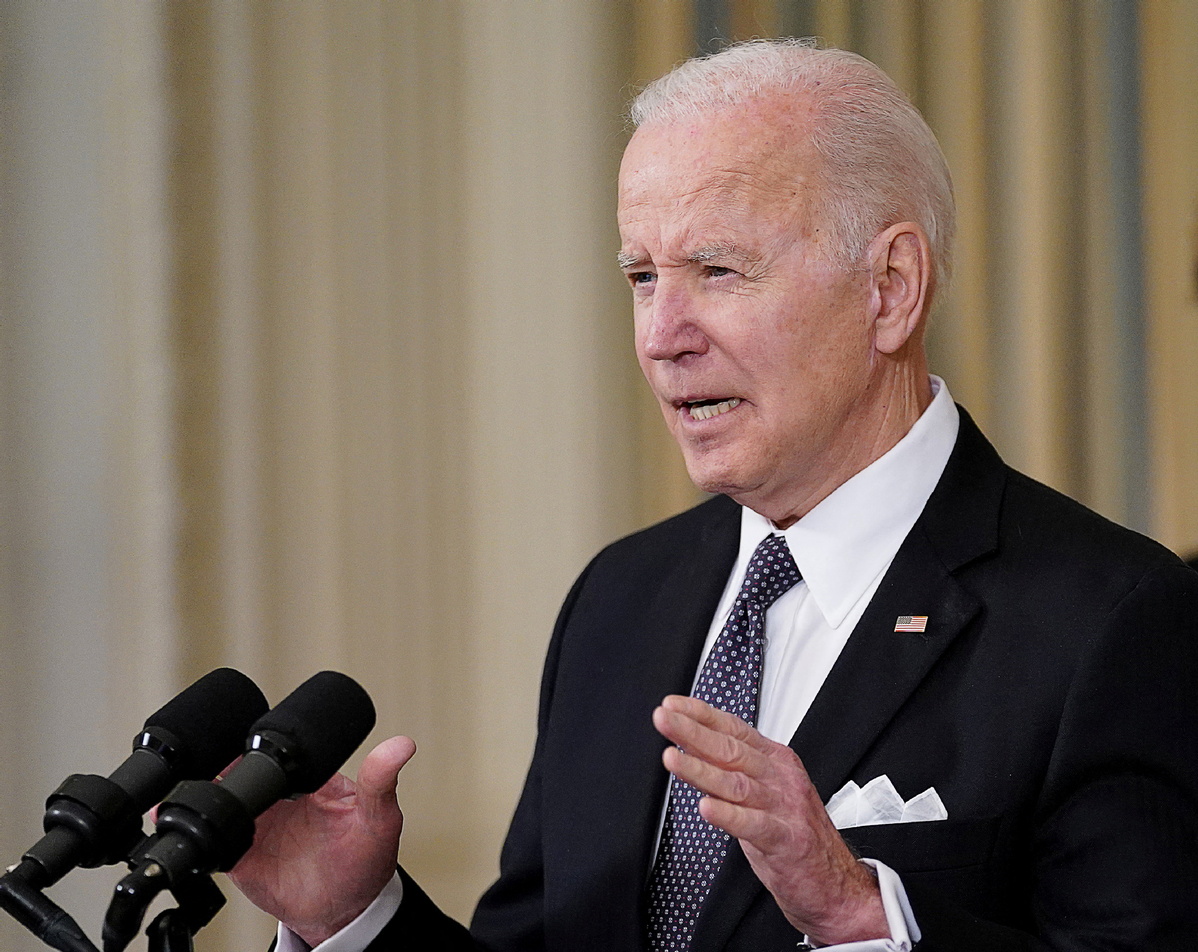
WASHINGTON - The administration of US President Joe Biden on Monday proposed 6.9 billion US dollars in its fiscal year 2023 budget proposal, which is aimed at addressing what it views as threats stemming from the military conflict between Russia and Ukraine.
"This funding will enhance the capabilities and readiness of US Forces, (North Atlantic Treaty Organization) allies, and regional partners in the face of Russian aggression," read a budget document, referring to what Russia said was a special military operation in Ukraine that started more than a month ago.
Also included in the 5.8-trillion-dollar fiscal year 2023 budget, in which the administration asked Congress to appropriate a total of 773 billion dollars for the Defense Department, is a sum of 682 million dollars for Ukraine "to counter Russian malign influence and to meet emerging needs related to security, energy, cybersecurity issues, disinformation, macroeconomic stabilization, and civil society resilience," according to the document.

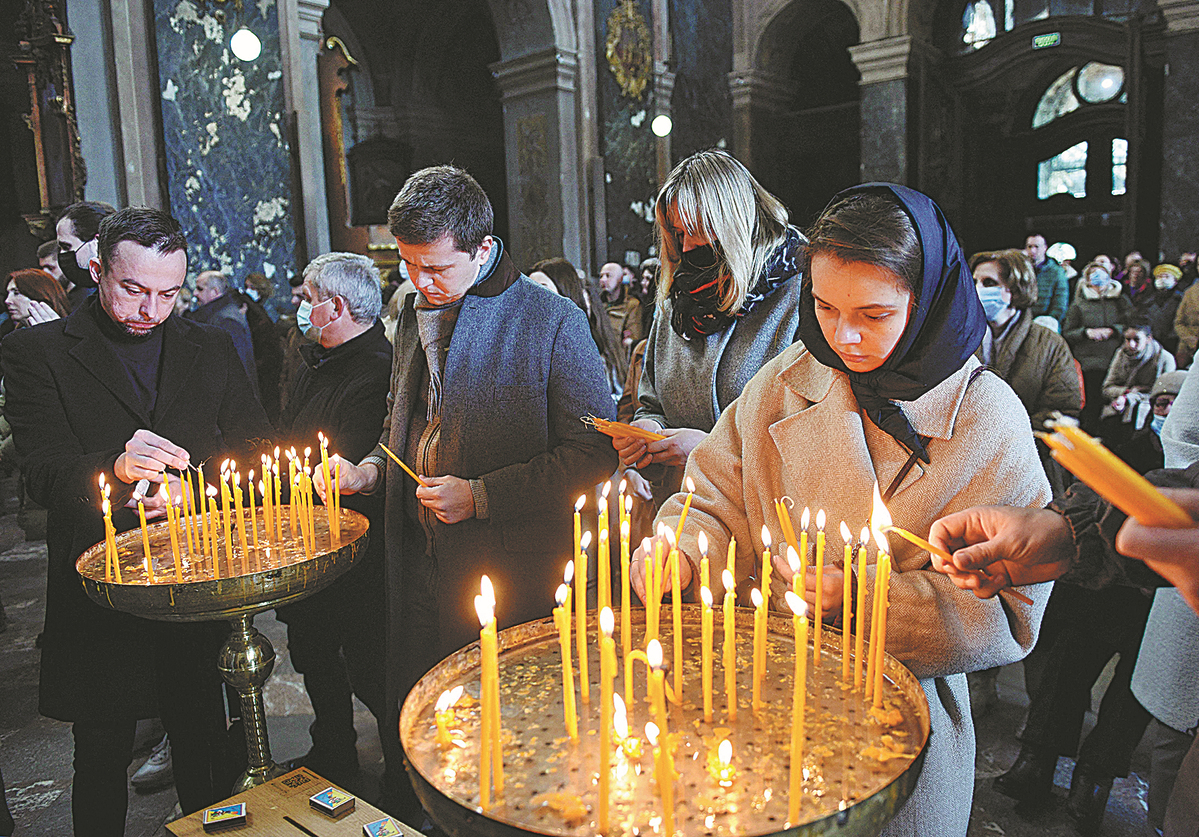
Apparent regime change call hosed down in US, but concerns heightened
Whether it was his intention or not, US President Joe Biden's remark in Poland about the status of Russian President Vladimir Putin has turned up the political temperature between the two countries over the military conflict in Ukraine.
In a speech on Saturday at the Royal Castle in Warsaw, Biden said of Putin: "For God's sake, this man cannot remain in power."
A White House official moved to clarify the remark, saying: "The president's point was that Putin cannot be allowed to exercise power over his neighbors or the region. He was not discussing Putin's power in Russia or regime change."
On Sunday, US Secretary of State Antony Blinken told journalists in Jerusalem after a meeting with Israel's foreign minister: "We do not have a strategy of regime change in Russia or anywhere else, for that matter. In this case, as in any case, it's up to the people of the country in question. It's up to the Russian people."
The remark about Putin, which reportedly was not part of the speech text, was seen as a distraction from the goal of ending the conflict.
"What it tells me, and worries me, is that the top team is not thinking about plausible war termination," Michael O'Hanlon, a senior fellow at the Brookings Institution told The Washington Post. "The only way to get to war termination is to negotiate with this guy.
"When you say this guy must go, you've essentially declared you're not going to do business with him. However appealing at an emotional level, it's not going to happen. We can't control it, and it probably won't take place anytime soon."
Richard Haass, president of the Council on Foreign Relations, told the Post: "There ought to be two priorities right now: ending the war on terms Ukraine can accept, and discouraging any escalation by Putin. And this comment was inconsistent with both of those goals."
James Freeman, a columnist for The Wall Street Journal, was blunter in his assessment. "Some issues are just too important to be left to an unscripted Joe Biden," wrote Freeman, adding that "these are dangerous times and we would all be much safer if Mr Biden would make greater use of prepared statements on subjects such as, for example, weapons of mass destruction", referring to a recent comment by Biden on US policy on the use of nuclear weapons.
Julianne Smith, the US ambassador to NATO, told the CNN network that the US "does not have a policy of regime change in Russia. Full stop."
Senator Jim Risch of Idaho, the top Republican on the Foreign Relations Committee, said he wished the Democratic president "would stay on script".
'Horrendous gaffe'
Risch told CNN that raising the notion of regime change would "cause a huge problem", calling the remark a "horrendous gaffe" and that "there's not a whole lot more you can do to escalate than to call for a regime change".
On Friday, the White House had to reiterate that US troops will not be going to Ukraine after the president alluded to such a scenario when addressing members of the Army's 82nd Airborne Division in Poland.
An NBC News poll released on Sunday but conducted before Biden's trip to Poland gave him the lowest approval rating of his presidency-40 percent.
The survey of 1,000 people conducted by one Republican and one Democratic pollster found that 71 percent had "just some" or "very little" confidence in Biden's ability to respond to the Ukraine-Russia conflict, including 43 percent of Democrats.
Eighty-two percent said they worried that the Eastern European clash could result in the use of nuclear weapons; 74 percent fear US troops will end up fighting in Ukraine, and 83 percent worry that it will exacerbate high inflation.
On domestic issues, the disapproval rate was 63 percent. The president, as is typical in such surveys, took a good portion of the blame. On inflation, 38 percent blamed Biden.
Agencies contributed to this story.

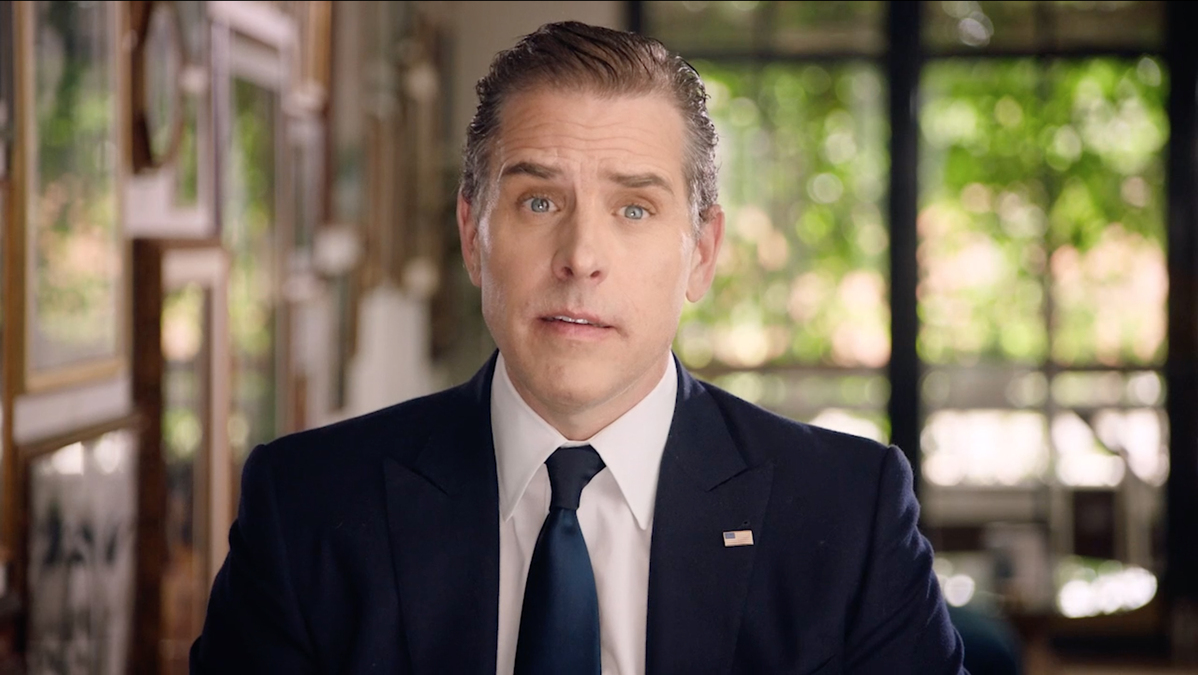
The much-scrutinized laptop computer of Hunter Biden includes emails that connect the US president's son to biological laboratories in Ukraine, according to allegations by the Russian government and recent media reports.
Moscow has claimed that secret American biological-warfare labs in Ukraine were a justification for its military incursion into its Eastern European neighbor last month. On March 24, the Kremlin alleged that the labs produced biochemical weapons.
"An investment fund run by … Hunter Biden funded research and the implementation of the United States' military biological program. It is obvious that Joe Biden, as his father and the head of state, was aware of that activity," Russian State Duma speaker Vyacheslav Volodin said, according to Russian media. Volodin called for a US congressional investigation and a White House explanation.
"Incoming material allowed us to trace the interaction scheme between US government agencies and the Ukrainian biolab," Igor Kirillov, head of Russia's Radiation, Chemical and Biological Defense Forces said at a March 24 briefing.
American intelligence officials had earlier dismissed Russia's claims as war propaganda, explaining that Ukraine's network of biological labs researching pathogens was not secret and had publicly received funding from Washington.
Russia's new claim, however, that Hunter Biden's investment fund was involved in raising money for biolab projects in Ukraine is accurate, according to emails first obtained by the New York Post and initially reported by the Daily Mail of London on March 25.
Rosemont Seneca Technology Partners invested $500,000 in Metabiota, a pathogen-research company headquartered in San Francisco, and raised millions more through firms that included Goldman Sachs, according to emails found on the computer, which was abandoned at a Wilmington, Delaware, repair shop in April 2019.
Rosemont Seneca is an investment firm based in Washington DC. It was founded in 2009 by Hunter Biden, Christopher Heinz and Devon Archer.
Heinz is the stepson of former US secretary of state and senator and current climate czar John Kerry. He is also the great-great grandson of Henry J. Heinz, founder of the international food processing company famous for Heinz ketchup. Archer is a businessman who was Heinz's classmate at Yale University.
The Post reported on the laptop after it received data from the computer from Rudy Giuliani, the Republican former mayor of New York and a legal adviser to Donald Trump, in October 2020. The story was denounced as Russian propaganda by former American intelligence officials and Democratic politicians shortly before the US presidential election, in which Joe Biden defeated Trump.
The Post's story was suppressed on social media and resulted in the newspaper's suspension by Twitter, which cited its "hacked materials" policy for not allowing the story to be distributed on its platform, a rule that the social media company has since eased.
The New York Times, in a March 17 story centered on a federal tax investigation into Hunter Biden's business dealings, reported that emails from the laptop were "authenticated".
"People familiar with the investigation said prosecutors had examined emails between Mr. Biden, Mr. Archer and others about Burisma and other foreign business activity," the Times reported. "Those emails were obtained by The New York Times from a cache of files that appears to have come from a laptop abandoned by Mr. Biden in a Delaware repair shop. The email and others in the cache were authenticated by people familiar with them and with the investigation."
Hunter Biden introduced Metabiota to officials at Burisma, the Ukrainian gas company where he was a highly paid board member, for a "science project" involving biolabs in Ukraine, according to the emails.
Metabiota says on its website that it "has over a decade of experience partnering with industry and governments worldwide to build resilience to epidemics and protect global public health".
Metabiota has worked in Ukraine for Black & Veatch, an American defense contractor with ties to military intelligence agencies, which built secure labs in Ukraine, according to the Daily Mail.
Metabiota's then vice-president Mary Guttieri wrote to Hunter Biden about geopolitical issues involving the company's research in the former Soviet republic in April 2014, two months after Russia annexed the Crimea region, according to the emails.
"As promised, I've prepared the attached memo, which provides an overview of Metabiota, our engagement in Ukraine, and how we can potentially leverage our team, networks, and concepts to assert Ukraine's cultural and economic independence from Russia and continued integration into Western society," her memo read.
Sam Faddis, a former senior CIA officer who reviewed the laptop's emails, told the Daily Mail that the offer to help drive Ukraine's independence was unusual.
"It raises the question. What is the real purpose of this venture? It's very odd," he said.
Four days after Guttieri's email, Burisma executive Vadym Pozharskyi wrote to Hunter Biden about an "as you called 'Science Ukraine' project".
"As I understand the Metabiota was a subcontract to principal contractor of the DoD (US Department of Defense) B&V [engineering firm Black & Veatch]," his email read. "What kind of partnership Metabiota is looking for in Ukraine?"
The US awarded $23.9 million to Metabiota later in 2014, with $307,091 allocated for "Ukrainian research projects", government spending records showed.
The younger Biden, 52, boasted to investors that his company organized funding for Metabiota and helped it "get new customers" including "government agencies", according to the emails.
B&V had been commissioned in 2010 by the US Defense Threat Reduction Agency to build a lab in Odessa, Ukraine, to "enhance the government's existing surveillance systems to detect, report and respond to bioterrorism attacks, epidemics and potential pandemics", the company's website said.
"The DoD position is that there's nothing nefarious here; this is pandemic early-warning research," Gaddis told the Daily Mail. "We don't know for sure that's all that was going on."
Hunter Biden remains under federal investigation for possible tax fraud. The probe was widened in 2018 to look into how his international business dealings as a lobbyist and investor coincided with his father's political career. He and the president have denied allegations of impropriety.


Bloc has developed since Cold War 'to better serve US hegemony'
Editor's Note: China Daily presents a series of analyses to make readers around the world better understand the how and why behind China's views and decisions on the Ukraine situation. This is the second installment of the series.
Long before the outbreak of the lingering Ukraine crisis, Beijing had been criticizing NATO's consecutive expansion, reminding the world that the United States-led military bloc is accountable for initiating and fueling the tragedy by providing weaponry.
NATO's presence should have ended at the end of the Cold War, it has a record of creating warfare, and its expanding reach is also threatening the hard-won peace in Asia, officials and scholars said.
"Beijing's negativity on NATO's legitimacy and its frequent expansion is not something recent but a long-standing and consistent position in recent decades," said Yuan Zheng, deputy director of the Institute of American Studies of the Chinese Academy of Social Sciences.
Instead of being buried alongside its traditional rival-the Warsaw Treaty Organization, "NATO has developed into an encompassing grouping to better serve US hegemony and boost defense interdependence among its members, countering the world's pursuit for peace", Yuan said.

NATO convened a summit on Ukraine on Thursday. That day was also the 23rd anniversary of NATO launching 78 days of airstrikes against the Federal Republic of Yugoslavia in 1999, targeting everything from medical facilities to schools, killing thousands of people and leaving nearly 1 million people displaced.
"We will not kneel and we will not beg, we want to keep the memory of the victims, and we will never forget what you did to this country and people," Serbian President Aleksandar Vucic said at a memorial event on Thursday.
Chinese Foreign Ministry spokesman Wang Wenbin mentioned on Friday a missile attack in 1999 by NATO forces on the Chinese embassy in Belgrade that killed three Chinese journalists, as well as NATO's use of depleted uranium bombs-prohibited by international conventions-during the airstrikes.
"Before reflecting on their crimes against people in countries like Serbia, Iraq and Afghanistan, the US and NATO have neither the right nor the authority to judge others," he said.
"All those who truly love peace and are committed to advancing peace will resolutely reject NATO's continued expansion," he added.
The US-led NATO is accountable for opening the Pandora's box of the Ukraine crisis, and "Washington, with a huge obsession regarding its hegemony, started meddling in the Ukraine situation back in the 1990s", said Diao Daming, an associate professor of US studies at Renmin University of China in Beijing.
"NATO has kept expanding eastward by adding new members in Europe five times, and US-led Western countries decided to define Ukraine as a geopolitical tool for containing and cornering Russia, leading to the Crimea crisis in 2014 and what is happening right now," Diao said.
Over the past months, NATO members "have stepped up military support, providing anti-tank and air defense systems, drones, fuel and ammunition" to Ukraine, Jens Stoltenberg, NATO's secretary-general, told reporters on Wednesday.
A statement by NATO heads of state and government on Thursday said the bloc "will continue to provide further political and practical support to Ukraine".
The bloc had been playing the role of initiator by providing weaponry before and during the Ukraine crisis, and this role was mirrored and enhanced by US President Joe Biden's recent push to boost NATO deployment in Eastern Europe, said Wang Fan, vice-president of China Foreign Affairs University.
The military bloc serves the US' need to seek absolute security "based on the insecurity of other countries", and now this can be seen in Europe-especially those nations bordering Ukraine and Russia-which stand on the forefront of the humanitarian crisis and face mounting security risks, Wang said.
"The ever-expanding NATO appears omnipotent with regard to many issues, but it seems to be incompetent when it is time to solve issues such as the Ukraine crisis," said Cui Hongjian, director of the European studies department at the China Institute of International Studies.
Vice-Foreign Minister Le Yucheng has openly questioned the legitimacy of NATO, calling it "a Cold War vestige" that "should have been consigned to history alongside the Warsaw Treaty Organization" with the disintegration of the then Soviet Union.
"In recent years, it even went so far as to flex its muscles in the Asia-Pacific. One could well anticipate the consequences of going down this path. The crisis in Ukraine is a stern warning," Le said at a forum on March 19.
The ongoing Ukraine crisis has also triggered increasing concerns in countries and think tanks in the Asia-Pacific region over NATO's role in the area, as well as the US boosting military alliances with countries in the region in order to counter China.
On Feb 11, the Biden administration unveiled a new version of its Indo-Pacific Strategy, saying that "competition with China" was one of the "urgent challenges" and calling for greater alignment and military buildup with its allies in the region.
"Such an 'Indo-Pacific Strategy'is as dangerous as the NATO strategy of eastward expansion in Europe. If allowed to continue unchecked, it would bring unimaginable consequences, and ultimately push the Asia-Pacific over the edge of an abyss," said Le, the vice-foreign minister.
This strategy seeks to build an "Asia-Pacific version of NATO" and safeguard the system of hegemony led by the US. China is ready to work with various parties to boycott the "Indo-Pacific" clique that works for confrontation, Deng Xijun, China's ambassador to ASEAN, said at a virtual news conference on March 21.
Yang Baoyun, a professor of ASEAN studies at Thammasat University in Bangkok, Thailand, said the US strategy "aims to use alignment to create new divisions and rifts among countries in the region, force them to take sides, sabotage existing regional security architecture, and serve US self-interests".
"It is inevitable that the Ukraine crisis will have a spillover effect on Asia. The existing problems in the region, if improperly handled or utilized by outsiders such as the US, may lead to major conflicts," Yang warned.
Several NATO members such as the US and the United Kingdom have sent warships and warplanes to the South China Sea in recent years, prompting strong protests from Beijing.
At a virtual meeting with NATO Secretary-General Jens Stoltenberg in September, State Councilor and Foreign Minister Wang Yi warned that NATO should "adhere to its original geographical positioning "and play a constructive role in securing the region's peaceful and stable development.
"Washington is still trying to incite countries involved in the South China Sea issue such as Vietnam and the Philippines to counter China," said Chen Xiangmiao, associate research fellow of the National Institute for South China Sea Studies.
It is unlikely that the US will break the strong ties built between China and ASEAN countries, and "it is not fully aware of the resentment of most regional countries toward major countries' competition and their strong concerns that such competition may lead to conflicts", Chen said.
The US' attempt to build up a series of new multilateral alignments in this region "is disrupting and tearing down the regional security architecture with ASEAN at its center," Chen warned.

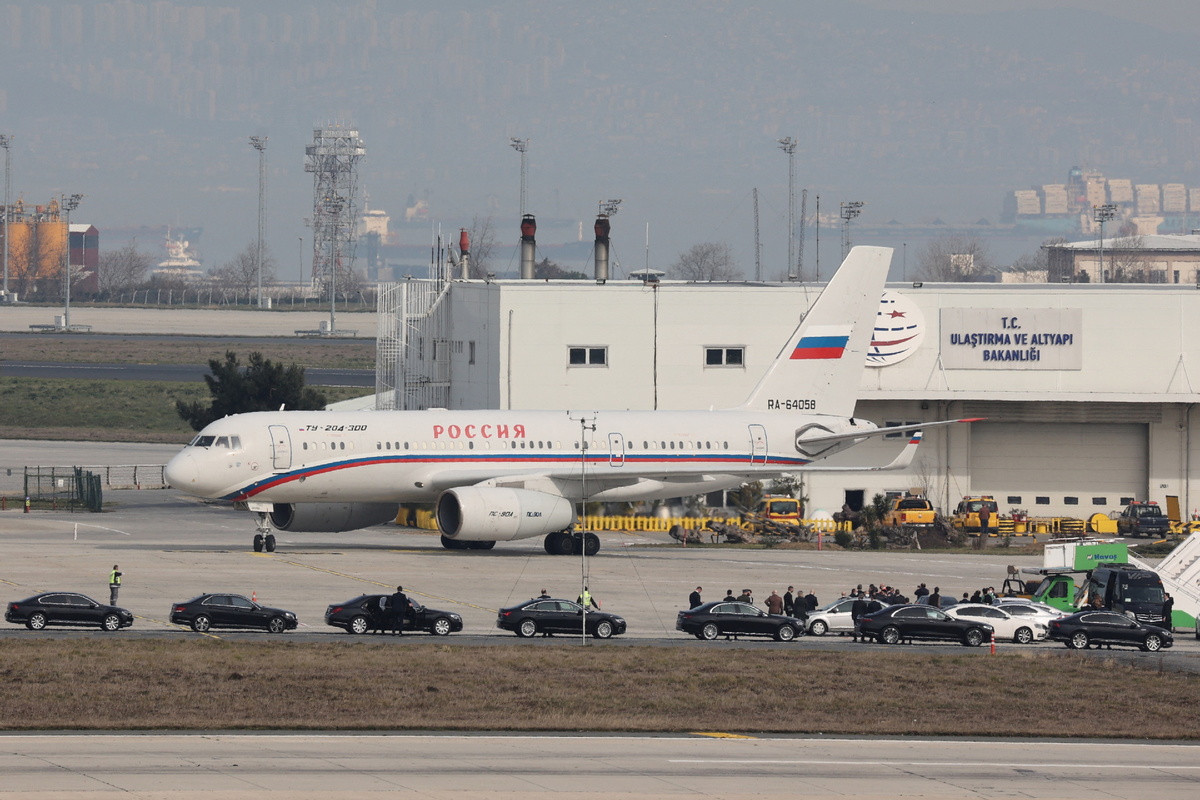
ISTANBUL - The Russian and Ukrainian delegations have arrived in Turkey's largest city Istanbul on Monday for a fresh round of face-to-face peace talks, aiming to achieve substantial progress to end the crisis.
The Russian delegation has settled in the Ciragan Palace Kempinski hotel while the Ukrainian delegation has checked in the Shangri-La Bosphorus, both very close to each other in the Besiktas district.
Media reports said the arrival of the Ukrainian delegation had been postponed to evening hours due to the closure of Ukrainian airspace and some logistical problems. According to the NTV broadcaster, the Ukrainian delegates had to go to a neighboring country by road to fly to Istanbul.
Tuesday's negotiations will begin at 10:30 am local time (0730 GMT) at the Dolmabahce Presidential Working Office in Besiktas.
Turkish President Recep Tayyip Erdogan is expected to address the delegations at the opening of the meeting.
"We will have a short meeting with the delegations tomorrow morning," Erdogan said at a press conference after a cabinet meeting in the Turkish capital Ankara on Monday.
So far, Russia and Ukraine have held three rounds of in-person talks in Belarus, and their fourth session was in a video conference format.
Turkey, meanwhile, has increasingly accelerated its diplomatic efforts on the international arena, reiterating its policy that it is ready to play a mediator role for lasting peace in the region.
In a phone call on Sunday, Erdogan told his Russian counterpart, Vladimir Putin, that a ceasefire and peace between Moscow and Kiev must be achieved as soon as possible, and the humanitarian situation in the region should be improved.
Erdogan repeated that Turkey would continue to contribute in every possible way during this process.
The "phone traffic" that he has been conducting with Putin and Ukrainian President Volodymyr Zelensky is progressing in a positive direction, Erdogan said on Monday.
Turkey has been exerting significant efforts to resolve the crisis through agreement and dialogue, he said.

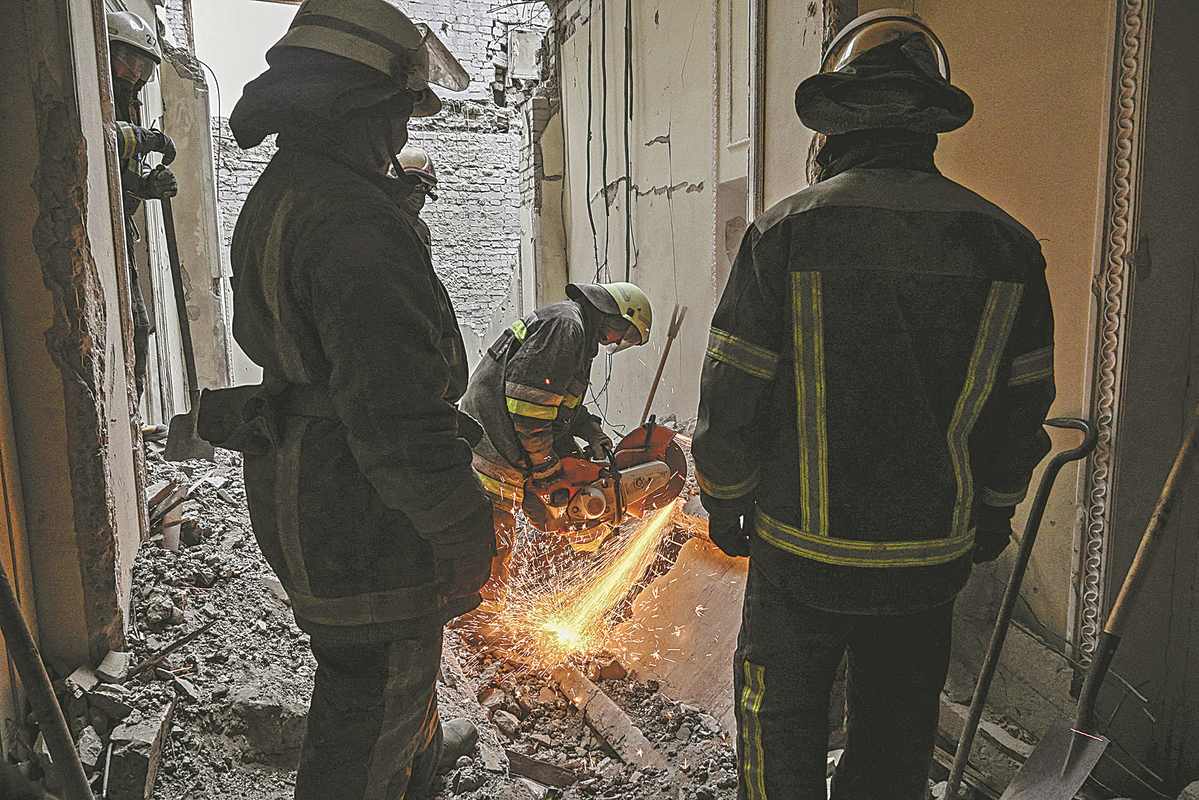
Russian and Ukrainian negotiators will resume face-to-face talks as soon as Tuesday in Istanbul, according to a Russian presidential aide on Sunday, with Ukrainian President Volodymyr Zelensky saying that his country is willing to accept neutrality as part of a peace deal.
The holding of the next round of in-person meetings was announced on Sunday by Russian presidential aide Vladimir Medinsky, who also leads the Russian delegation to the talks. Russian President Vladimir Putin and his Turkish counterpart Recep Tayyip Erdogan earlier that day spoke by phone.
According to the Turkish presidential office, Erdogan told Putin that his country will continue its mediation efforts in an effort to establish peace between Russia and Ukraine.
"President Erdogan stressed the necessity of reaching a truce and peace between Russia and Ukraine as soon as possible, and of improving the humanitarian situation in the region. He added that Turkey will continue to make its contribution to this process," Erdogan's office said.
Medinsky wrote on his social network account earlier on Sunday that a regular round of online talks with Ukraine was held, and he confirmed the agreement for officials from the two sides to meet in person on Tuesday and Wednesday.
Turkey said the talks could begin as early as Monday, but Kremlin spokesman Dmitry Peskov said that was unlikely as the negotiators would only be arriving on Monday.
Zelensky spoke optimistically about the new negotiations, saying he hoped they would bring peace "without delay" and lamented the effects of a monthlong Russian special military operation.
Neutral status
Ukraine is ready to accept a neutral status as part of a peace deal with Russia, Zelensky said.
Any agreement would have to be put to the Ukrainian people in a referendum, he said. But Zelensky once again stressed his desire to reach a concrete peace agreement.
"Ukraine's sovereignty and territorial integrity are beyond doubt. Effective security guarantees for our state are mandatory," Zelensky said in a late-night video message that also set out his negotiating bottom lines.
Zelensky called for Moscow to halt the bombardment of cities like Mariupol, where officials said the situation is "catastrophic".
Several attempts at establishing safe routes for civilians to flee have collapsed as both sides traded accusations of violating temporary cease-fires.
About 170,000 civilians remain trapped in Mariupol without adequate food, water or medicine, according to Ukraine's foreign ministry. Russia said the Ukrainian military has been holding the civilians as "hostages" in the southern port city.
France, Greece and Turkey hope to launch a "humanitarian operation" to evacuate civilians from Mariupol within days, according to French President Emmanuel Macron.
Macron warned on Sunday against a verbal "escalation" of the situation after United States President Joe Biden called Putin a "butcher" who "cannot remain in power", a remark the Kremlin snapped back at. It said, "a head of state should stay sober".
Macron said he would speak to Putin in the next few days to organize the evacuation of civilians from Mariupol.
German Chancellor Olaf Scholz said his country is against any suggestion of sending NATO peacekeepers to Ukraine.
"We will not act there in the military sphere even if one calls it peacekeeping troops," he said. "We won't aspire to create a no-fly zone there."
Scholz said he was doing "everything to help Ukraine". Currently "sanctions are the main tool "against Russia, he said.
Leonid Pasechnik, the head of the self-proclaimed republic of Lugansk, said a referendum on becoming part of Russia may be held in the near future.
But the proposal was opposed by Russia's lower house of parliament, with the head of the State Duma Committee on the Commonwealth of Independent States Affairs, Leonid Kalashnikov, saying it's "not the right time to do this now".

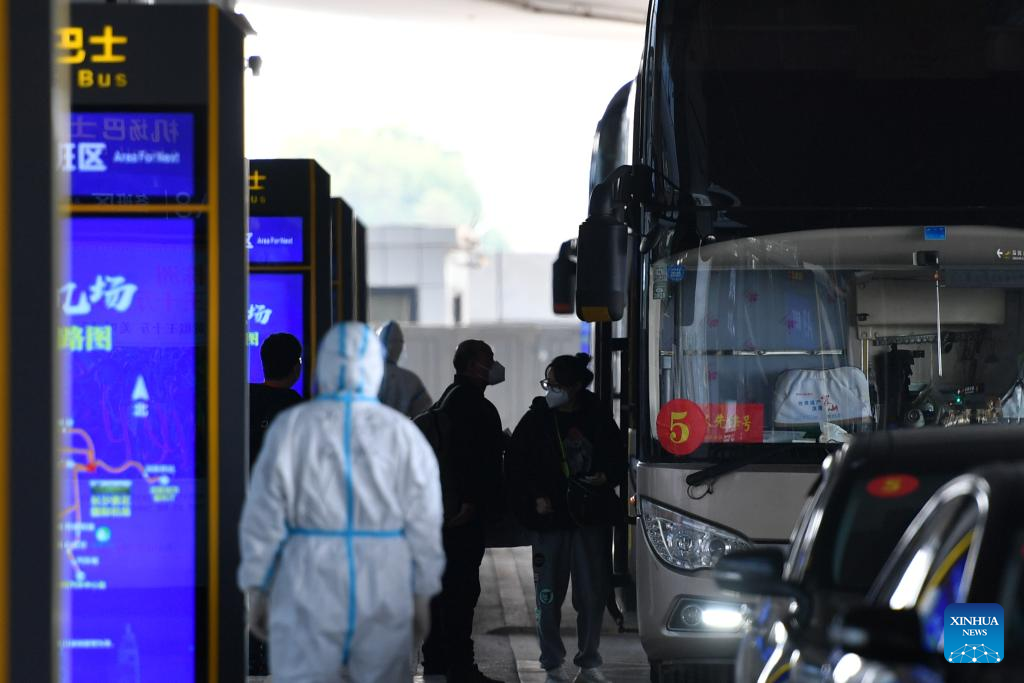
More than 4,600 Chinese citizens evacuated from Ukraine have safely returned to China following the arrival of the final special flight in Fuzhou, Fujian province, on Monday, marking the temporary end of the country's evacuation work, Foreign Ministry spokesman Wang Wenbin said.
Since the Chinese government sent the first chartered flight on March 4 to Bucharest, capital of Romania, a total of 20 have been organized to bring back Chinese nationals evacuated from Ukraine after the situation there deteriorated.
"During the whole evacuation process, over 5,200 Chinese citizens were safely evacuated to Ukraine's neighboring countries. All of those citizens who voluntarily left Ukraine have been safely evacuated, except for one individual who got injured while driving," Wang said.
Wang added that as the Chinese government worked on the relocation and evacuation of Chinese nationals, the government and various sectors in Ukraine showed goodwill and provided assistance.
Countries including Russia, Moldova, Romania, Poland, Hungary, Slovakia and Belarus also provided valuable support, he said.
"We would like to express our sincere gratitude to those governments and peoples," he said.
While the evacuation has basically come to an end, the spokesman stressed that the work of protecting the safety and legitimate interests of Chinese nationals overseas never stops.
"With concrete steps, we will show every one of our compatriots overseas that we stand with you at all times, wherever you may be, you have us behind you, behind you is the motherland," Wang added.
Speaking on the Ukraine issue, the spokesman reiterated China's position that sanctions are never an effective means to resolve problems, noting that more than 140 of the 190 members of the United Nations are not participating in sanctions against Russia.
He added that normal trade contacts between Russia and other countries, including China, have suffered unnecessary damage due to sanctions imposed on Russia.
"We urge the United States to seriously take into consideration China's concerns when dealing with the Ukraine issue and US-Russia relations, and to refrain from undermining China's legitimate interests in any form," he said, adding that China will take all necessary measures to firmly safeguard the lawful rights of Chinese companies and individuals.

ISTANBUL - The Russian delegation has arrived in Turkey's largest city Istanbul on Monday for a fresh round of peace talks with Ukraine, the CNN Turk broadcaster reported.
The plane carrying the Russian representatives landed at the Ataturk Airport, which is exclusively used for diplomatic missions, it said.
According to Turkish diplomatic sources, the talks are expected to begin on Tuesday morning.
In a phone call on Sunday, Turkish President Recep Tayyip Erdogan and his Russian counterpart Vladimir Putin agreed to hold the next round of negotiations in Istanbul.
Erdogan reiterated that Turkey would continue to contribute in every possible way during this process.
So far, Russia and Ukraine have held three rounds of in-person talks in Belarus, and their fourth session was a video conference.

KYIV - Ukrainian President Volodymyr Zelensky said that the Ukrainian delegation is looking for peace at the fresh round of talks with Russia, the presidential press service reported Monday.
"Our goal is obvious - peace and the restoration of normal life in our native state as soon as possible," Zelensky said.
As other top Kyiv priorities at the talks, Zelensky listed Ukraine's sovereignty, territorial integrity and effective security guarantees.
On Sunday, a member of the Ukrainian delegation David Arakhamia said the next round of negotiations between Ukraine and Russia would take place in Turkey on March 28-30.
Ukrainian and Russian delegations have held three rounds of negotiations in person in Belarus since Feb 28, and the fourth one started on March 14 in the format of a video conference.

A US professor of international law said the US-led NATO's expansion is the root cause of the Russia-Ukraine conflict.
Francis A. Boyle, a professor of international law at the University of Illinois, made the remarks in an interview to China Daily's Pan Yixuan.
Boyle said former US secretary of state James Baker, during the tenure of then US president George H.W. Bush, as well as many then European NATO states' leaders made a solemn pledge before former Soviet Union leader Mikhail Gorbachev saying NATO would not expand to the east if the Soviet Union agreed to the two Germany's reunification. The promise is binding as a matter of international law, Boyle stressed.
However, according to Boyle, the continuous expansion of NATO has irked Russia, and the US-led NATO rejected Russia's objection, which made the situation deteriorate drastically.
?
To help address the disaster in Ukraine, Boyle said the US should respond to Russia's concerns about a buffer zone and announce that NATO will not expand, and Ukraine will not join NATO as a member state.
Boyle also said that China could play a bigger role of mediator to ease the crisis.
?
?
?
?
?
?
?
?
?
?
?
?
?
?
?







