


Are you ready for robots to roam your streets?









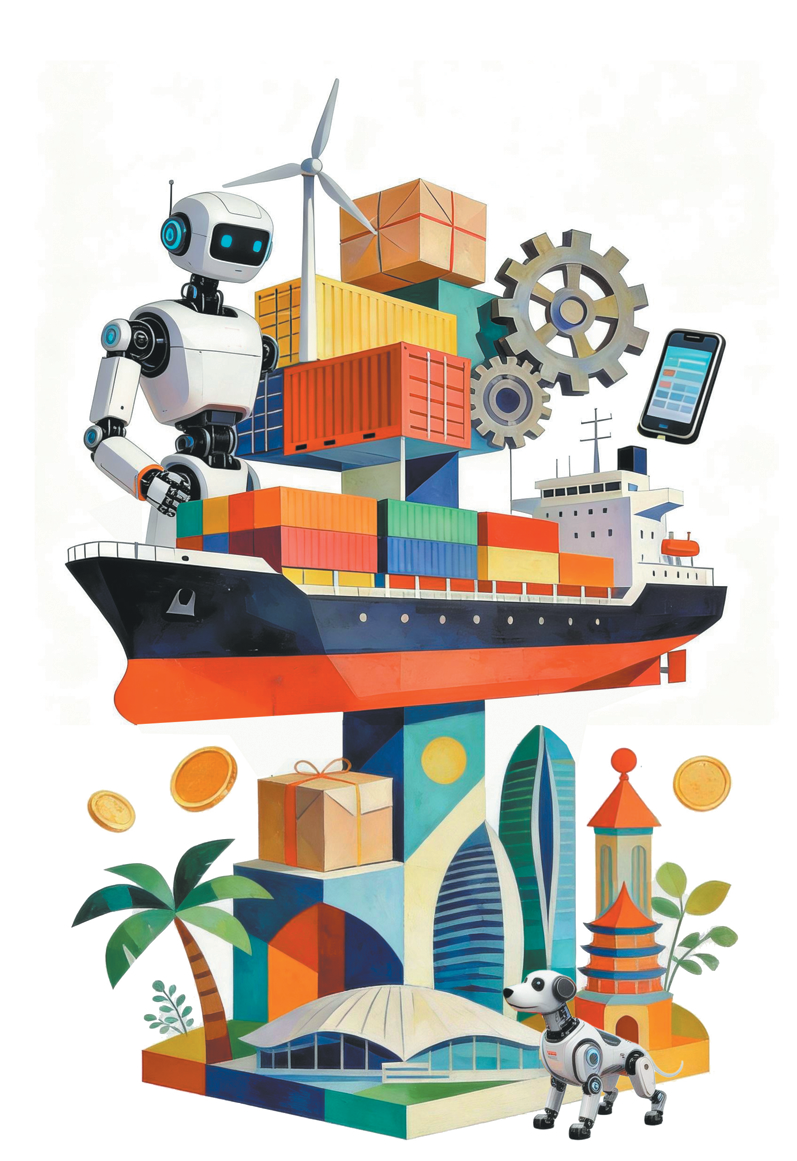
Global leaders are gathering in Davos, Switzerland, from Monday to Friday for the World Economic Forum's annual meeting, with dialogue and coordination taking center stage amid growing calls for practical cooperation. A key focus is the paradigm shift in technology, from artificial intelligence to next generation energy systems, reshaping how we live and work.
2026 will be the year when robots become a visible part of our everyday life. How should we prepare our cities for their arrival? In 2025, we witnessed the growing presence of autonomous robots — robots capable of operating without direct human control — on our streets and sidewalks. A Unitree robot can now carry shopping bags for a human, as a video circulated on Douyin demonstrates.
Waymo's self-driving cars ferry passengers around 10 American cities, with more on the way. When I first arranged for a Waymo car in San Francisco two years ago, I was astonished to see the driverless car coming to pick me up, and equally astonished as it navigated skateboarders, double-length buses, cars, bicycles, and pedestrians with seeming ease. Soon, robots will routinely run errands for us.
When automobiles first appeared on British streets in the 19th century, lawmakers confronted a similar challenge: how to make sure a disruptive new technology was safe for the public? Beginning in 1861, Parliament enacted stringent regulations governing what were then called "locomotives," a term we now reserve for trains. The most restrictive of these laws, the locomotives act of 1865, limited vehicle speeds to 2 miles per hour (3.21 kilometers per hour) in the city and 4 miles per hour in the countryside. Cars were required to operate with a crew of two people along with a third person walking 60 yards ahead carrying a red flag. When the most onerous provisions of these "Red Flag" laws were finally repealed in 1896, some celebrated with an "Emancipation Run" of cars from London to Brighton.
Today, as robots appear on the streets of China or the United States, we face a similar question: how do we keep the public safe as robots appear on our streets and sidewalks? Do we need Red Flag laws for the age of robots?
Public acceptance of robots will depend heavily on trust, particularly with respect to privacy and cybersecurity. People will expect that robots record only what is necessary and that access to any data be strictly limited. They will want to know who has access to these recordings. In fact, humans should be allowed to access these only under strict conditions. Law enforcement, too, should be required to follow proper legal procedures before accessing such data.
We should consider specialized rules — such as requiring public recording devices to indicate when they are recording, perhaps with a light. This might apply to robots, drones, and smart glasses alike.
In addition, robots operating on public roads and sidewalks should be required to meet appropriate safety standards. The International Organization for Standardization, for example, has developed a safety standard for personal care robots and is in the process of updating the standard to reflect rapid technological change.
As we write these rules, we should remain attentive to the benefits robots can bring, especially for the elderly and the disabled. Helper robots will be especially valuable in rapidly aging societies. Waymo is testing its vehicles in Japan, a country where the workforce has been shrinking since 1995. An International Monetary Fund paper dubbed Japan the "land of the rising robots", a moniker that will soon be appropriate for more and more countries.
Tragic encounters with robots can provoke public backlash. In 2018, during testing in Arizona, an Uber self-driving car struck a woman who was walking her bicycle laden with shopping bags across a multi-lane road at night outside a crosswalk. The human safety driver, who was supposed to be monitoring operations, looked up from her phone too late. This was the first recorded instance of a pedestrian fatality involving a self-driving vehicle and the resulting public outcry led Uber to dismantle its self-driving car research.
More recently, in October 2025, a neighborhood cat named "Kit Kat" was killed when it hid under a stopped Waymo car in San Francisco. While tragic, this incident did not lead to the suspension of Waymo's operations, in part because many recognized that the company's cautious approach had likely saved countless human lives. Indeed, some San Francisco bicyclists report feeling safer when they are approached by a Waymo car than a car driven by a human. We should recognize that, like humans, robots will make tragic mistakes — and respond with reason rather than overreaction. Of course, I hope that Waymo's systems are being reviewed to ensure that they try to protect animals as well as humans.
Science fiction writer Isaac Asimov once imagined a future in which humanity banishes intelligent robots from Earth, confining them to outer space. By building safety, accountability, and privacy into robots from the start, we can work toward a future where robots are a welcome part of our lives.
The author is Scott K. Ginsburg Professor of Law and Technology at Georgetown University Law Center.
The views don't necessarily reflect those of China Daily.
If you have a specific expertise, or would like to share your thought about our stories, then send us your writings at opinion@chinadaily.com.cn, and comment@chinadaily.com.cn.