


Doctor by day, rocker by night









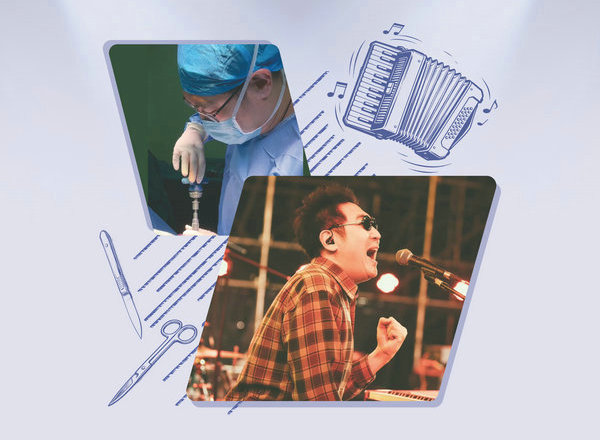
At 9 am, beneath the shadowless surgical lights of an operating room at Beijing's China-Japan Friendship Hospital, Ma Haoning's hands move with practiced precision over a patient's spine. Each motion is measured and controlled, navigating the fragile balance between nerve and bone.
More than 10 hours later, those same hands glide over black-and-white piano keys, conjuring the passionate melodies of the rock band Penicillin under intense stage lights and the roar of amplifiers.
This contrast is a defining feature of Ma's life. He lives with a dual identity: an attending physician in the spinal surgery department of a prestigious hospital and the keyboardist of a well-known rock band.
When asked whether he is "the most rock-and-roll doctor" or "the best surgeon among rock musicians", Ma answers without hesitation: "Definitely the former. Being a doctor will always be my main job."
His response reveals the clear priority within his two lives and reflects a grounded version of the modern "slashie" — someone who pursues multiple careers or roles simultaneously. For Ma, being a slashie is not a vague attempt to "have it all", but a deliberate choice to expand life's breadth and flexibility while remaining anchored in a stable professional foundation.
His parallel paths began with an old accordion called Dongfang Hong — "The East is Red". It once belonged to his mother, who had to give up her musical ambitions as a young woman during a time of material scarcity.
Ma started learning the accordion at the age of 5, fulfilling the dream his mother was unable to realize.
These two paths truly began moving forward in parallel — and at full speed — after he entered clinical practice and established himself as a doctor. His parents' attitude toward his musical pursuits also evolved from cautious watchfulness to wholehearted support.
His week is carefully structured: two days dedicated to surgery, one day to outpatient clinics, and the remaining time is split among teaching, research, and patient care and management.
On surgery days, his work often runs late into the night, sometimes stretching into the early hours of the morning. Band rehearsals are usually squeezed into whatever time remains after work or reserved for weekends.
Ma credits his ability to stay energetic and manage his time effectively to "self-discipline" and "sacrifice". Instead of spending his downtime scrolling through short videos, playing video games, or watching much TV, he channels his limited energy with great focus.
"Don't let minor distractions disrupt your life's rhythm," he said. "Be willing to sacrifice unnecessary socializing or entertainment."
According to Ma, both being a good doctor and being a good musician require "very solid foundational skills". Medicine is an empirical science built on years of accumulated knowledge and experience, while music demands deep training in both performance and theory.
Yet at their core, the two are built on very different principles. Medicine follows strict scientific procedures and leaves little room for error. "In many situations, we are simply not allowed to innovate casually," Ma noted. In contrast, music is "more relaxed, offering much more space for experimentation and creativity".
For him, switching between rational and intuitive thinking is not a burden. Rather, the two worlds complement and strengthen each other.
This synergy is evident in both his hands and his mindset. He believes that years of practicing music have significantly improved the dexterity essential for a surgeon. And the separations, deaths, and everyday human dramas he witnesses in the hospital have given him a deeper understanding of humanity and emotion — experiences that, in turn, become authentic nourishment for artistic creation.
"When you engage with music or any kind of artistic way of thinking, you're able to approach people with more empathy — to truly feel and understand the suffering illness brings," he explained. "Medicine is ultimately about people. It's a profession that carries great warmth."
Despite shouldering a dual burden, Ma finds that the sense of accomplishment is doubled as well. As a doctor, the essence of flawless surgery lies in the realization of self-worth; as a musician, a successful performance brings the joy of contributing to the band and connecting with the audience.
"Excelling in either of these pursuits is profoundly meaningful," he said.
Ma admires Queen's legendary guitarist Brian May, who is both an astrophysicist and a rock star. "When he attended academic conferences, people would ask him to sign CDs," Ma said. "He's an idol to me. He reminds me that it's possible to thrive in two completely different fields."
As a vivid example of the slashie lifestyle, Ma believes it will become mainstream in the future.
"Today, many people live multifaceted lives," he said. "With improved living conditions, more individuals develop well-rounded qualities from a young age, cultivating their own hobbies and specialties."
"Society is also becoming more supportive of these lifestyles," he added. "People are increasingly open-minded and encouraging toward those who pursue multiple paths — and that reflects social progress."
Many internet users have praised Ma's choice, saying that his very existence is proof to young people with multiple passions that, with focus and diligence, the possibilities in life are far broader than they might imagine.
"To young people worried about managing everything, I want to say: don't be afraid of failure; dare to try, and have the courage to persist," Ma advised.
Huang Xuemeng and Shan Shuo contributed to this story.