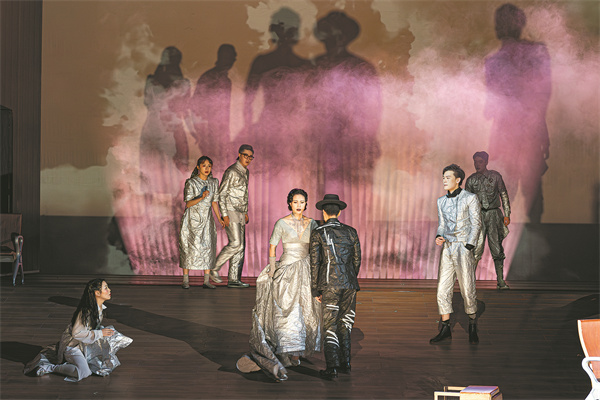
The set and staging seem to reflect this collapse of time. At one point, when the wealthy merchant Lopakhin, who ultimately buys the estate, proposes cutting down the cherished cherry orchard to build villas, the destruction of the orchard — symbolizing the end of an era — becomes more than just a plot point. It represents the clash between old ideals and new realities.
Although Chekhov claimed the play was "a comedy, sometimes even a farce", audiences and readers frequently perceive a hint of tragedy in the fall of the once-elegant Ranevskaya family. The humor embedded in Chekhov's writing, while subtle, becomes clear in director Doiashvili's vision.
"From our perspective, Chekhov's work might feel a little heavy, and we struggle to understand why he would consider the sale of the cherry orchard a comedy," says Yang Mingxin, who plays Lopakhin. "But as we got deeper into rehearsal, I began to understand. It's not the plot that's funny; it's the people in the story."
The absurdity lies in how the characters, especially the aristocrats, refuse to listen to Lopakhin's practical suggestions for saving the orchard, instead mocking his ideas. This rejection of reality and his role as the voice of reason amid confusion forms the comedic foundation of the play.
"The more I studied the script, the more I admired Chekhov's writing. Every character has depth, and none of them is expendable," Yang says.