



Study advances understanding of soil microorganisms on alpine ecosystems









LANZHOU -- Chinese scientists have newly uncovered the patterns and drivers of soil microbial communities in alpine grasslands and deserts on the Qinghai-Tibet Plateau, according to the Northwest Institute of Eco-environment and Resources (NIEER) under the Chinese Academy of Sciences.
Conducted by the NIEER researchers, this new study helps advance the understanding of soil microorganisms on alpine ecosystems on the Qinghai-Tibet Plateau, said Li Yuqiang, a researcher from the NIEER who led the study.
Soil microorganisms in alpine grasslands and alpine deserts play a vital role in the functions of alpine ecosystems.
Researchers investigated and conducted a comparative study on the geographic distribution, co-occurrence patterns and assembly processes of topsoil microbial communities in alpine grasslands at the altitude of 3,165-4,903 meters and alpine deserts at the 3,150-5,200 meters of the eastern part of the plateau.
They conducted studies on the within-habitat diversity, which refers to the species diversity present within a specific location or habitat, focusing on the topsoil bacteria and eukaryotes in the two types of ecosystems.
Contrary altitudinal distribution patterns have been found between the topsoil bacteria or eukaryotes. In alpine grasslands, both groups exhibit a significant linear decrease with increasing altitude, whereas in alpine deserts, they show a significant linear increase as altitude rises.
Among the two types of ecosystems, soil bacterial assembly in alpine grasslands and deserts is shaped by stochastic and deterministic processes. Meanwhile, stochastic processes dominate the assembly of eukaryotes in alpine grasslands and deserts, according to the study.
Biodiversity conservation is crucial to the survival and development of humanity. Understanding the mechanisms that generate and maintain biodiversity can help to predict trends in the evolution of ecosystem functions, according to Duan Yulong, an associate researcher of the NIEER.
"This new study also provides a key scientific basis for predicting the dynamics of soil microbial communities and changes in their ecological functions in alpine ecosystems given the background of climate change," Duan added.




- Study advances understanding of soil microorganisms on alpine ecosystems
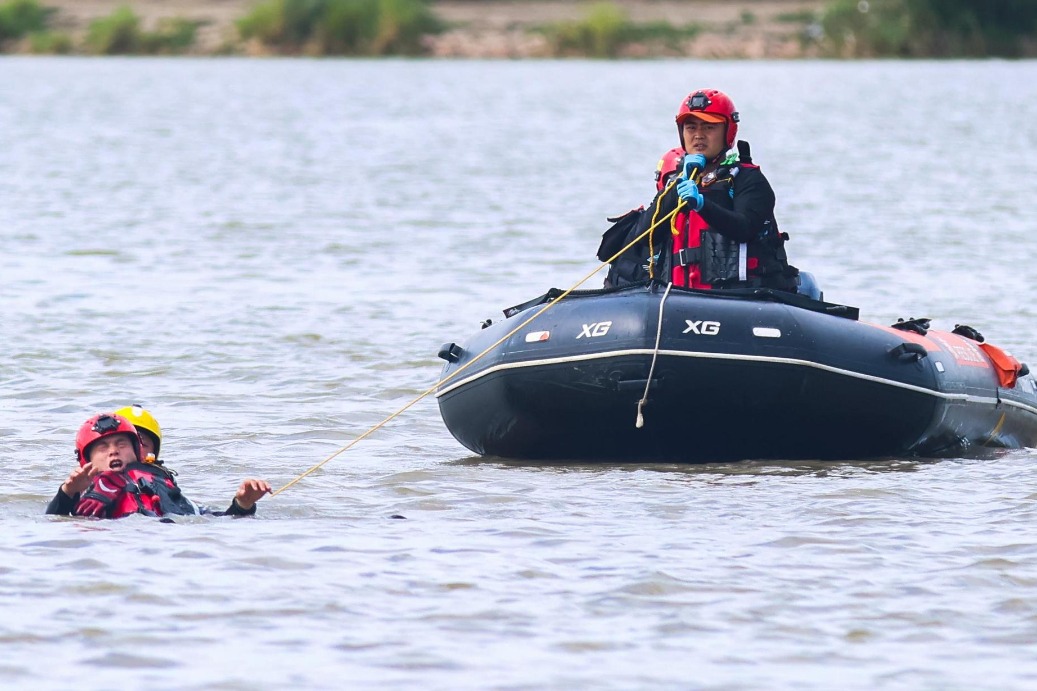
- Water surface rescue drill held on Harbin section of Songhua River in Heilongjiang, NE China
- Chinese researchers discover East Asia's oldest sauropodomorph dinosaur
- Main tower of bridge across Beijing-Hangzhou Grand Canal witnesses topping-out
- Macao SAR chief executive meets with HKSAR chief executive
- Landslide leaves 7 missing in China's Guangzhou