


Sweet smell of success for incense masters









From the 11th to the 14th century, the city grew into the largest settlement of Arabs and Persians in the Far East. Some of them took root and never moved, married local Chinese, and became part of the community.
In 1646, Pu Shimao, one of Pu Shougeng's descendants fled to Hankou village in the mountainous county of Yongchun to escape war and turmoil in Quanzhou, bringing with him traditional Arabic incense making skills.
His arrival gave birth to the incense industry in the remote village where the family made and traded incense for a living. The Pu family shared their unique techniques with fellow villagers, opening the era of incense making in Yongchun as the industry flourished and spread throughout the county.
The industry reached its heyday in the 1930s when Pu Shuli, Pu Lianggong's grandfather, opened a store by a wharf in a suburb of Yongchun and managed to expand his business to Southeast Asia and Japan through the port of Quanzhou.
Pu Shuli also sent his son to Vietnam to set up a branch and purchase local aromatics for the main store, and then sold their products to southeastern Asian countries, Japan, and Europe.
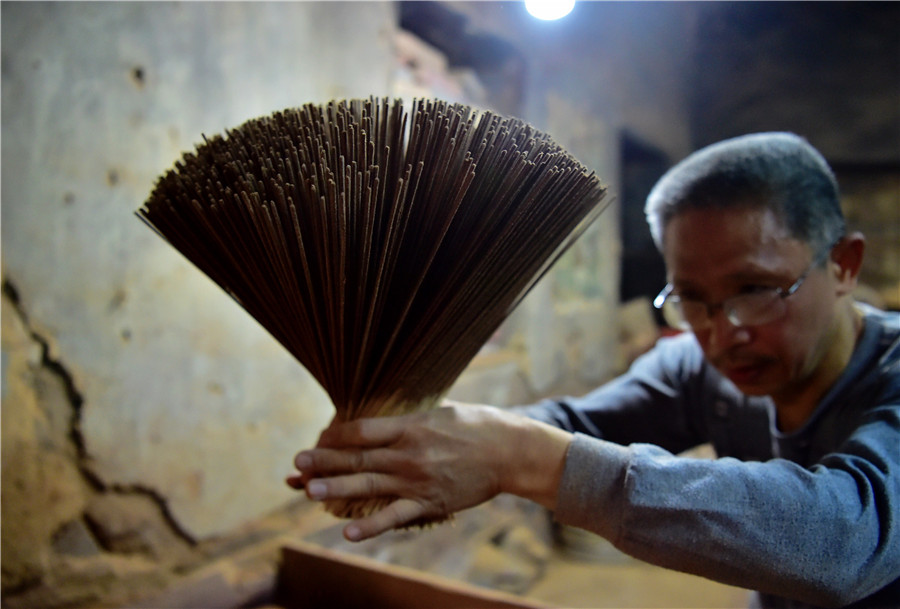
Today, there are about 300 incense manufacturers in Yongchun, with more than 30,000 people working in the industry. It is said that one in every three incense sticks sold in Southeast Asia is made in Yongchun.
Like their maritime trader forefathers, the Pu family and other villagers endeavor to revive the trade in scent brought by their Arab ancestors.





- Yuyuan Lantern Festival puts Shanghai in festival mood
- Cargo ship capsizes off Hainan coast, two crew missing
- China's Shenzhou XXI astronauts in good health, science goals on track after 3 months in space
- Sixth episode of photo series explores stunning landscapes across Hebei
- 19 people jailed over deadly 2023 Beijing hospital fire
- Shanghai launches first Pudong new year cultural festival