Decades don't dim memory of Sino-Japan war
(Reuters)
Updated: 2006-07-07 14:35
Zhang Jingru stands quietly before the photo exhibit: Chinese victims of
Japan's germ warfare experiments, emaciated slave labourers, corpses of children
killed during a Sino-Japanese war begun 69 years ago on Friday.
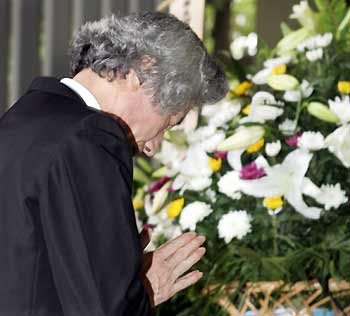
Japanese Prime Minister Junichiro Koizumi
prays for the unknown soldiers and civilians killed in World War Two at
Chidorigafuchi National Cemetary in Tokyo August 15, 2005.
[Reuters] |
As its name suggests, the Memorial
Museum of the Chinese People's Anti-Japanese War is dedicated to preserving
memories of an eight-year war that killed tens of millions of Chinese before
Tokyo's 1945 surrender.
"We hate the actions done at that time," said the 22-year-old Zhang when
asked how she feels about the Japanese people now.
"We should not hate the Japanese people but they should remember this
history, and the Chinese people will not forget."
Others were even harsher.
"I have always hated the Japanese," said Gao Feng, 23, who like Zhang was on
a company trip to the museum near suburban Beijing's Marco Polo Bridge, where a
military skirmish on July 7, 1937, became a spark for an all-out Sino-Japanese
war.
He understood the Japanese of today are not the same as those who committed
the war atrocities.
"But still I don't like them. I don't know why, but from the bottom of my
heart, I don't like them," Gao said.
Japanese Prime Minister Junichiro Koizumi, whose visits to a Tokyo shrine for
war dead helped chill ties with China after he took office in 2001, visited the
museum in October that year and offered a "heartfelt apology" for the Chinese
people's suffering.
But Koizumi's repeated pilgrimages to Yasukuni Shrine, where Japanese leaders
convicted as war criminals by an Allied tribunal are honoured along with war
dead, have cast serious doubt for many Chinese on the sincerity of that and
later apologies.
"We Chinese not only care about what someone says. What is more important is
what he does," museum curator Wang Xinhua told Reuters.
|
