


China's new space exploration school eyes future interstellar travel









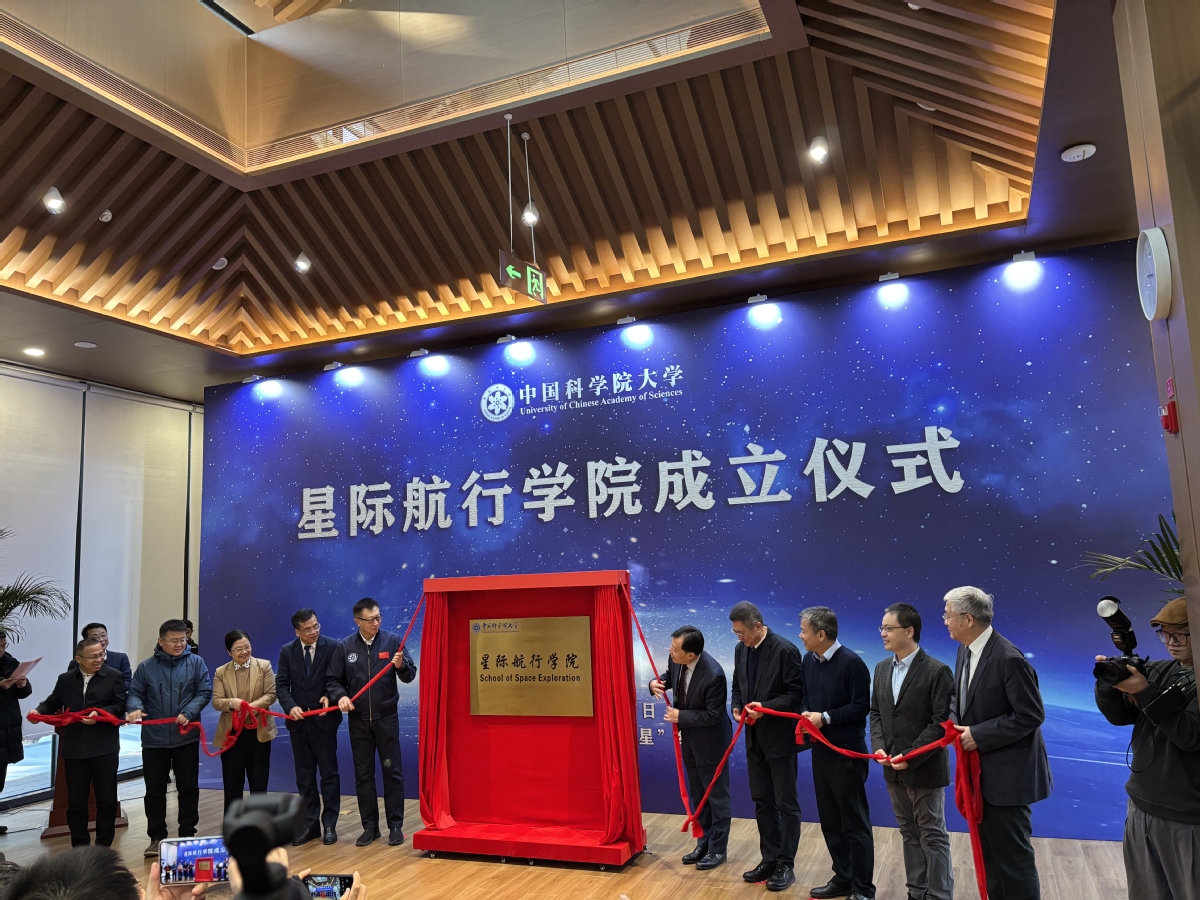
The University of Chinese Academy of Sciences (UCAS) unveiled its new School of Space Exploration on Tuesday in Beijing, marking a key step toward cultivating talent for China's deep space exploration and space science endeavors.
The inauguration ceremony was held at the Chinese Academy of Sciences memorial hall for the "Two Bombs, One Satellite" project on campus.
Zhu Junqiang, an academician of the Chinese Academy of Sciences and director of the CAS Bureau of Strategic High-tech Development, has been appointed dean of the newly founded school.
The decision to form the school was made in November 2025, with a curriculum covering 14 first-level disciplines and specialties, including aerospace science and technology and planetary science.
Building on 97 existing courses, the school will introduce 22 new core subjects, such as interstellar dynamics and propulsion principles, space environment perception and utilization, planetary dynamics and habitability, and interstellar sociology and governance.
UCAS President Zhou Qi emphasized that the school's establishment responds to the new era of space exploration. "We have already stepped beyond Earth — building a space station, exploring the far side of the moon, and launching missions to Mars. It is time to think strategically about building the interstellar travel enterprise of the future," he stated.
Zhou acknowledged the widespread public interest that followed the school's initial announcement, noting that its delayed inauguration reflected a desire to move beyond "the glamour of the moment" and focus on substantial long-term planning. He paid tribute to the pioneering spirit of the "Two Bombs, One Satellite" generation, whose work in harsh conditions laid the foundation for today's achievements.
The school is designed to be inherently interdisciplinary and institutionally collaborative. Zhou highlighted that over 100 CAS research institutes are connected to its mission.
"When we embark on the journey of interstellar travel, we will face every kind of scientific and practical challenge — from navigation and space weather to spacecraft engineering, space agriculture, and even interstellar diplomacy. No single institution or discipline can accomplish this alone," he explained.
He also stressed that the school must look beyond existing academic boundaries. "We cannot merely follow in the footsteps of others to the moon, Mars, or beyond the solar system. We must develop our own strategic vision and build a scientific system that serves the future common needs of humanity," Zhou said.
A key focus of the school will be talent development. "We have established not just a project, but a school, and the heart of a school is nurturing people," Zhou said. He called on all participating institutes and experts to prioritize students' growth and provide them with platforms to "see farther and go farther."


- Gansu leads China in museums per capita
- Cornell students and faculty explore agricultural development in China during cultural exchange program
- Taiyuan State-owned liquor factory head suspended after assault on former distributor
- Fujian accelerates cross-Strait integration efforts
- China's tech firm deploys AI model in orbit, unveils massive space computing plan
- Historic Wanping town in Beijing shines anew ahead of Spring Festival