


Staying cool under pressure
Ice master Mark Messer is the man tasked with creating the Games' first temporary indoor speed skating rink









A precise science
Messer's first Olympics was Calgary in 1988 — the first time speed skating was held indoors.
"That gave us some advantages, because we didn't have to worry about the weather — wind blowing or rain," he said. Now, he is upping the challenge by becoming the first ice master to build a temporary rink for the Olympics.
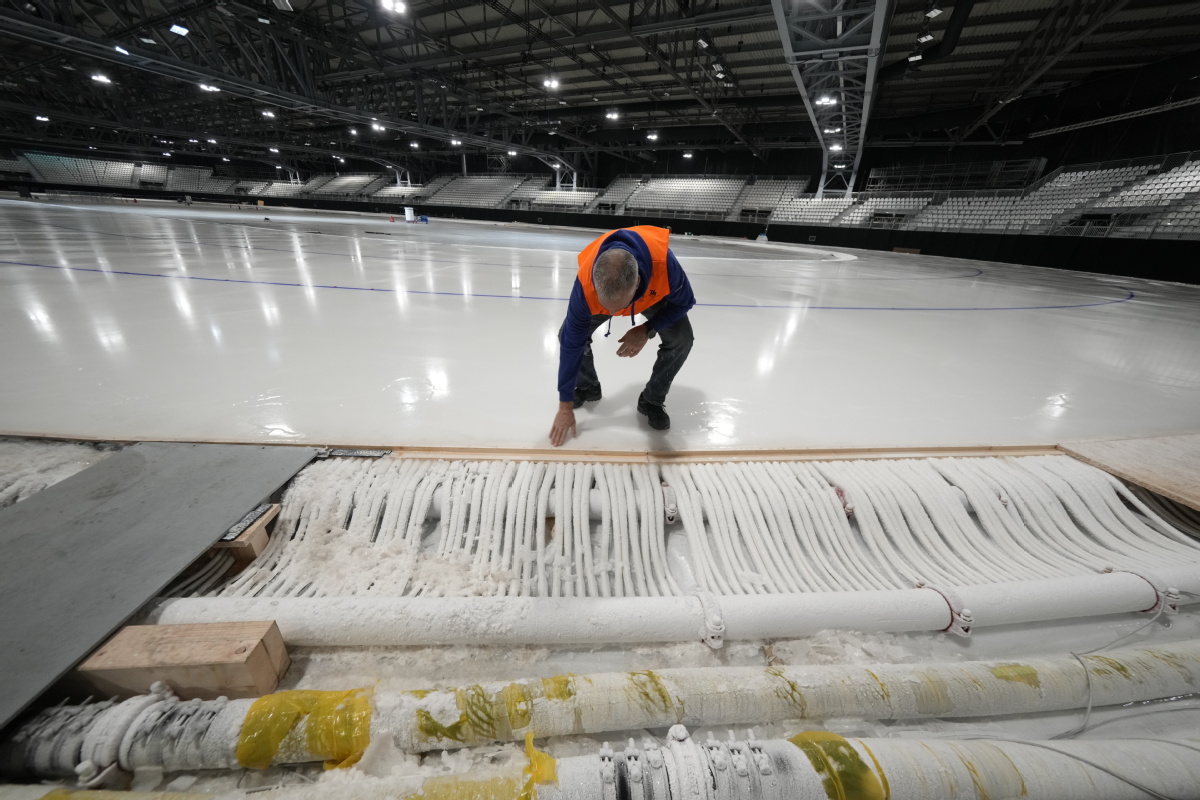
Before Messer arrived in Italy, workers spent weeks setting up insulation to level the floor and then a network of pipes and rubber tubes that carries glycol — a coolant — that is brought down to — 7 C or — 8 C to make the ice.
Water is run through a purification system — but it can't be too pure, or the ice that forms will be too brittle.
Just the right amount of impurities "holds the ice together," Messer said.
The first layers of water are applied slowly, with a spray nozzle; after the ice reaches a few centimeters it is painted white — a full day's work — and the stripes are added to make lanes.
"The first one takes about 45 minutes. And then, as soon as it freezes, we go back and do it again, and again and again. We do it hundreds of times," Messer said.
As the ice gets thicker, and is more stable, workers apply subsequent layers of water with hoses. Messer attaches his hose to hockey sticks for easier spreading.
What must absolutely be avoided is dirt, dust or frost — all of which can cause friction for the skaters, slowing them down. The goal is that when the skaters push, "they can go as far as possible with the least amount of effort," Messer said.
The Zamboni ice resurfacing machine plays a key role in keeping the track clean, cutting off a layer and spraying water to make a new surface.
One challenge is gauging how quickly the water from the resurfacing machine freezes in the temporary rink.
Another is getting the ice to the right thickness so that the Zamboni, weighing in at six tons, doesn't shift the insulation, rubber tubing or ice itself.
"When you drive that out, if there's anything moving it will move. We don't want that," Messer said.
Final adjustments
The rink got its first big test in November during a Junior World Cup event. In a permanent rink, test events are usually held a year before the Olympics, leaving more time for adjustments.
"We have a very small window to learn," Messer acknowledged.
Dutch speed skater Kayo Vos, who won the men's 1,000m gold, suggested the ice might be a little soft — but Messer didn't seem too concerned.
"We went very modest to start, now we can start to change the temperatures and try to make it faster and still maintain it as a safe ice," he said.
Fine-tuning the air temperature and humidity and the temperature of the ice must be done methodically — taking into account that there will be 6,000 spectators in the venue for each event. The next real test will be on Jan 31, when the Olympians take to the ice for their first training session.
"Eighty percent of the work is done, but the hardest part is the last 20 percent, where we have to try to find the values and the way of running the equipment so all the skaters get the same conditions and all the skaters get the best conditions,"Messer said.


Most Popular
- Over 300 athletes from 35 countries and regions kick off Asian championships in Tianjin
- Legacy of Beijing 2022 lives on as Milan welcomes Games
- Olympic cauldrons lit as Milan-Cortina 2026 opens
- Olympic atmosphere builds in Milan
- Nation's soccer strength reboots for a new era
- Champions lead Winter Olympics quest