

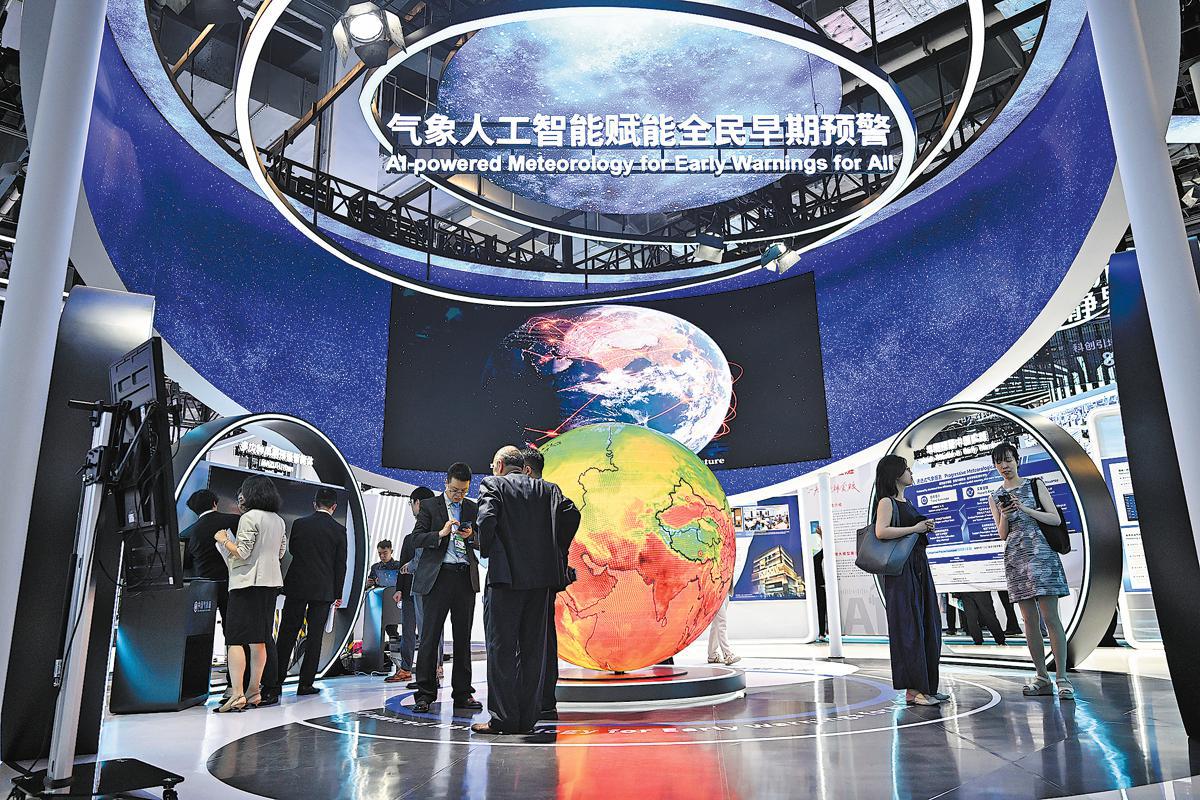
Chinese solution provides 'early warnings for all'
AI-driven forecasting mitigates weather-related risks in developing countries










Coastal connections
In Fujian, the cradle of Mazu culture, the ancient prayer for safe voyages is now answered by precise, hourly weather warnings. As a coastal province frequently battered by typhoons, Fujian has developed a sophisticated "1262"meteorological disaster prevention model utilizing the MAZU system.
The model works by pinpointing key risk areas 12 hours in advance, pre-positioning rescue forces six hours ahead, and identifying township-level high-risk zones two hours before a forecast weather event.
In July, when Typhoon Danas approached Fuzhou, capital of Fujian province, the urban drainage center, acting on meteorological warnings from the system, emptied 139 inner-city rivers in advance.
"Meteorological early warning is the vanguard for urban drainage," said Xue Yubin, deputy director of the Fuzhou Urban Hydrographic Net Joint Drainage and Dispatch Center. "It transforms our work from passive defense to active fortification," Xue said.
The model has benefited the province's fishery industry, especially the local farmers who make a living by raising abalone or growing seaweed. In the aquaculture hubs of Putian and Ningde, early warnings have played an important role in protecting the livelihood of fishermen and increasing farmers' income.
Yang Jianbin, an agronomist with the Xiuyu district aquatic technology extension station in Putian, said the value of early warnings for aquaculture comes from precise forecasting, advance prevention and loss reduction. Specialized services for seaweed farmers in Xiapu have helped avert losses exceeding 100 million yuan ($13.8 million) in recent years, according to local authorities.
The "1262" model has become a flagship case study of the MAZU solution, with its expertise in marine forecasting being shared with island nations such as the Solomon Islands.