


A journey comes full circle
An 11th-century literary giant faced punishment, but his writings are driving a heritage and economic revival in Hainan today, Chen Bowen reports in Haikou.









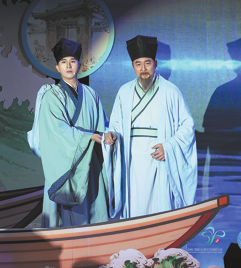
More than nine centuries ago, a weary, aging statesman-poet, battered by political winds, stepped onto a wooden boat on the northern shore of Hainan province, finally bound for home after three years in exile. He left behind a land then considered a remote, desolate outpost, but which he had, with characteristic defiant optimism, called home.
Today, Su Shi, also known as Su Dongpo, is steering a cultural and economic revival on that same tropical island, proving the enduring power of a singular, unbreakable spirit.
The third China (Hainan) Dongpo Culture and Tourism Festival, a yearlong extravaganza running from March 2025, is not merely a historical retrospective. It is a vibrant, sprawling experiment in making an 11th-century literary giant a catalyst for contemporary tourism, academic discourse, artistic innovation, and even coping with modern anxiety.
The festival's theme, Continuing the Dongpo Legacy, Promoting Dongpo Culture, is being realized through an array of over a dozen core events across multiple cities and counties, from academic symposiums to AI-powered musicals and pop concerts.
"Dongpo brought blessings to Hainan, and Hainan, in turn, shaped him," scholars agreed unanimously at the festival's International Forum on Dongpo Culture held on Nov 8 in Chengmai county, flipping the old narrative of "Hainan's fortune was born from Dongpo's misfortune".
The forum, attended by 139 scholars from across the globe, delved into this symbiotic relationship. When Su was banished to Hainan in 1097, the island was a remote region with difficult natural conditions. He responded not with despair, but with action, establishing schools, promoting agriculture, compiling medical texts, and penning 170 poems and 160 essays, including some of his most profound philosophical and literary works.
"He reached ultimate sublimation in his life here," Lin Anwu, honorary chair professor at Dong Hwa University, Taiwan, noted the poet's cross-Straits and cross-generational appeal.
"His spirit can basically deal with involution, lying flat, modern anxiety … his life was rich, vibrant, and radiant," Lin explained. "Even very meager materials could become a vibrant driving force for life in his hands."
This translation of ancient resilience into modern solace is the festival's beating heart. It aims to show that Su's answer to adversity, "Wherever my heart is at peace, that is my hometown," resonates in today's uncertain world.
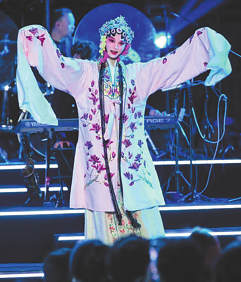
The festival's programming aims to bridge this millennium-old gap. In a striking fusion, the 2025 Hainan Dongpo Culture Songwriting and Singing Camp culminated in a grand finale concert on Dec 20 in Haikou, where 13 original songs, using online crowdsourcing and collaborations, reimagined Su's poetry through hip-hop, pop, and rock. One track, The Hunt, used a driving rap beat to channel the poet's "drawing a bow like a full moon" bravado. Another song, Charm of a Maiden Singer, combined Peking Opera recitative with pop singing, creating a temporal dialogue around his famous lines on life's transience: "The endless river eastward flows".
"We are using 21st-century melodies to deconstruct a millennia-old Dongpo spirit," said Dai San'e, the event's organizer, framing it as a "vivid practice" in cultural confidence for the Hainan Free Trade Port development.
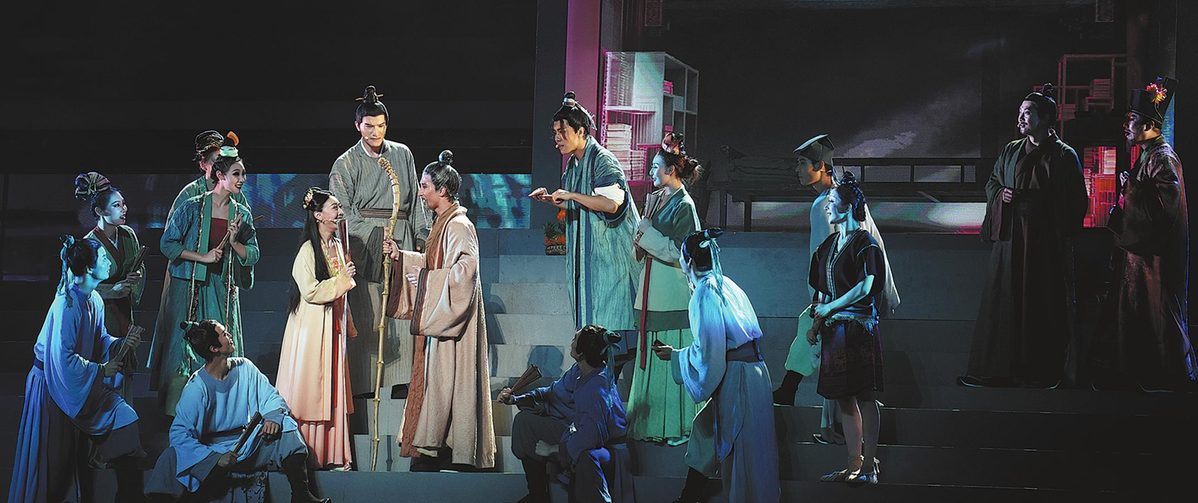
Perhaps the most audacious "crossover" project is Peace of Mind: Dongpo, billed as China's first original AI-themed musical. Premiering in November, the production uses AI as a narrative device to connect a modern college student with the exiled polymath, allowing a heartfelt dialogue across time.
Han Chaoguang, chairman of the Hainan Performing Arts Group, said the creative team immersed themselves in historical texts to sharpen Su's transformation from a man who felt "like an untethered boat" to a man who declared, "Hainan, thousands of li away, is truly my hometown."
The play has been so successful that a national tour, starting in Shanghai, is planned for this year, effectively making Su a cultural export from the island that once received him as an exile.
On the ground, the "Dongpo-ization" of Hainan's tourism landscape is palpable. At Haikou's old dock, shopping complexes are illuminated with projections of his verses. In Chengmai's Fushan Coffee Culture Town, marketers invoke his phrase, "the blandest fare is a joyful feast," to elevate a cup of locally grown coffee. In Danzhou city, at the historic Dongpo Academy he founded, students dress in traditional attire for immersive study tours, channeling the "sheer delight of the mighty wind coming from the sea".
"This innovation is the best inheritance of tradition," said writer Peng Tong, quoting Su's words on "creating new ideas within the established rules".
For Hainan, the three-year cycle of the Dongpo festival represents a response to the genuine heart that Su once held, and the opening of a new cultural current. Each concert, forum, and creative product is "like dropping stones into a long river of culture", creating ripples that keep the "source water" flowing, according to local cultural planners.
As Russian professor Aleksandr Storozhuk from St. Petersburg State University observed after the academic forum, the series of events demonstrates "exceptionally high academic standards" and "the cohesion and contemporary vitality of Hainan's Dongpo culture".
"During his exile in Hainan, Su Dongpo always spoke highly of Hainan's local customs and people with great enthusiasm. The people of Hainan, in turn, held him in deep respect, understood him sincerely, and offered him support. They mirrored and uplifted each other, creating a legacy of mutual enrichment," said Li Gongyu, chairman of the Hainan Su Research Association. "The Dongpo culture, timeless and ever-vibrant, stands as a globally influential representative of China's outstanding traditional culture. It continues to hold significant meaning for the development of the Hainan Free Trade Port today."
From a dampened exile departure point in Chengmai to a statewide, multi-year cultural celebration, Su's journey in Hainan has come full circle. The poet who once found solace and purpose on the island is now helping it find a deeper, more distinctive identity, proving that some historical contracts, written in ink and spirit, only grow richer with time.