


A new era, steeped in tradition
From high-end banquets to service-driven urban hubs, teahouses are emerging as cultural spaces and engines for consumer growth, Yang Feiyue reports.









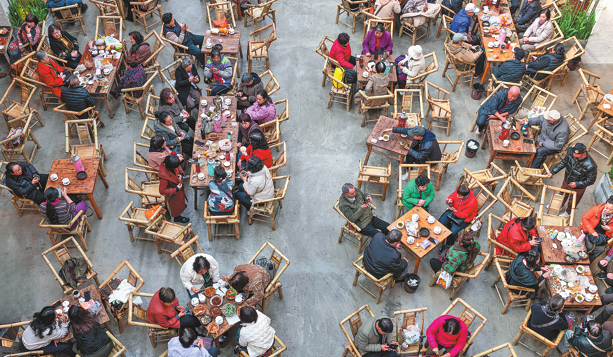
In a quiet neighborhood of Shanghai's North Bund, one can sense a subtle change in the flow of time after pushing open the door of Qiuping Tea Banquet, a teahouse that integrates tea with dining.
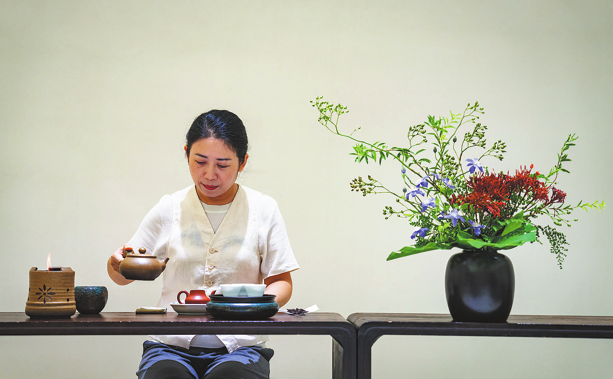
The space embodies a modern Chinese Zen aesthetic, featuring a light and natural palette of walnut wood and gray tones. The air carries a refined fragrance of tea, soon deepening into richer layers, as the earthy richness of oolong intertwines with savory quail eggs, the delicate sweetness of white tea woven into the texture of poached pork.
A guest's first stop is not the dining area, but a statue of Lu Yu, the revered Sage of Tea from the Tang Dynasty (618-907).
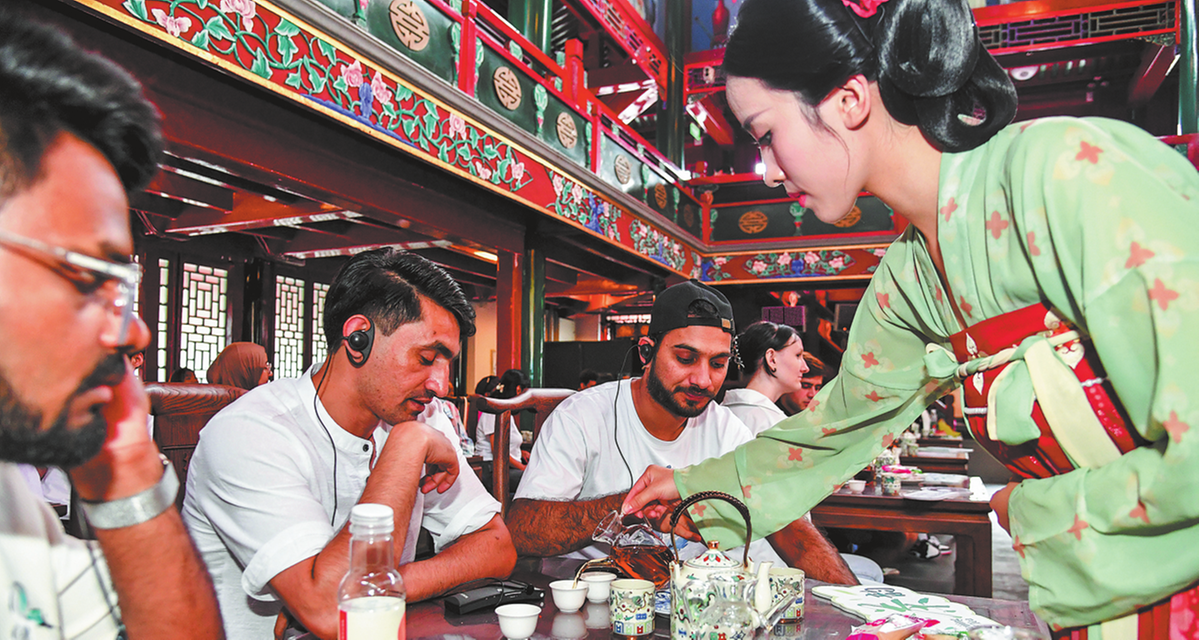
Guided by a tea attendant dressed in simple, elegant attire, whether a foreign visitor from afar or a local guest drawn by the teahouse's reputation, each person solemnly offers a cup of tea here, says Liu Qiuping, who founded the teahouse more than three decades ago.
"This is the first dialogue with more than a thousand years of tea culture, a moment of quiet ritual that settles the heart first," Liu explains.
From the tea offering and viewing the teahouse's museum-like collection of cultural artifacts relating to tea, to sitting down for an authentic tasting of the six major categories of tea, the culminating experience at the place is a full banquet where tea is integral to the cuisine.
"Many people think tea is only for drinking, but we have proven that tea can perfect a table of dishes," Liu says.
"Tea, possessing the character of 'a gentleman who helps others achieve their beauty', uses its complex aromas and inherent properties to subtly cut through grease and elevate natural sweetness, never masking the original flavor of the ingredients," she adds.
The development trajectory of this nearly 1,000-square-meter teahouse mirrors the evolution of the consumer market of China's tea culture.
Liu admits that initially, up to 70 percent of her clientele were foreign nationals and literati, drawn by this quintessential Eastern aesthetic experience.
A heartening trend is now taking shape.
"More and more ordinary people are walking in nowadays," she observes.
As public demand for quality of life and cultural experiences grows, the once seemingly lofty tea banquet is gradually reaching a broader audience.
With a peak daily capacity exceeding 100 guests, the tea banquet remains the core offering.
Yet, the process itself has transformed into a composite cultural service that encompasses ritual learning, artifact appreciation, tea education, and gourmet experiences.
Liu's story is part of a broader national revival of teahouse culture, backed by striking market figures.
At a recent teahouse industry conference in Beijing guided by the China General Chamber of Commerce, Meituan Research Institute, under the Meituan on-demand service platform, reported that nearly 180,000 teahouses were registered on its platform as of 2025.
Since 2019, the number of new teahouses listed annually has surged from 4,200 to 38,000, an impressive compound annual growth rate of 44.2 percent, the report states.
The data paints a vivid picture of a rapidly diversifying industry. High-end cultural teahouses now see an average customer spend exceeding 300 yuan ($42.9), while mainstream venues thrive in the 100-300 yuan range.
Growth is not limited to major cities. In third — and fourth-tier cities, teahouse numbers are expanding by 15 percent annually.
Traditional tea remains central, as over 60 percent of venues focus on classic tea service.
But shifting consumer behavior is reshaping the sector. The demand for social and group gatherings has become a core driver, alongside a rising appetite for ritualistic and immersive experiences, the report reveals.
Jiang Ming, Party secretary of the China General Chamber of Commerce, emphasizes that the teahouse sector serves as a key hub for realizing the value of the tea industry, a living vehicle for the transmission of tea culture, and an important scenario for service-based consumption.
In recent years, the industry has demonstrated remarkable vitality, he notes, from the emotional consumption trend of "boiling tea around the stove" to cross-sector innovations under the "tea culture plus" model.
"The sector is activating consumption potential through diversified formats, injecting fresh momentum into the upgrading and expansion of consumption during the 15th Five-Year Plan (2026-30) period, and playing an increasingly significant role in the national strategy of expanding domestic demand and boosting consumption," Jiang elaborates.
At the edge of the bustling crowds and traffic flow of Beijingnan (Beijing South) Railway Station, the teahouse Cha Zi Tang is quietly conducting an experiment that subtly challenges traditional notions of what a teahouse should be.
It forgoes deliberately crafted classical seclusion, with its first floor resembling more of a bountiful tea laboratory.
All six major tea categories are available, including rare varieties like yellow tea. Beyond tea leaves, shelves display precious herbal ingredients and other tea-substitute beverages and tonics, says founder Lei Mingfeng, a native of Ya'an, Sichuan province.
With 12 years' experience in navigating Beijing's tea industry, Lei says that two years ago, it was the right time for him to open a teahouse.
The core engine of this hub is hidden on the second floor. In contrast to the first floor's product displays, the upper level houses several clean, minimalist private rooms.
With a modest daily foot traffic of only 10 to 15 guests, this space is pivotal to Lei's business model.
"In Beijing, rent and labor costs are high. We must rely on enhanced service to quickly cover costs," he explains. His secret weapon is a "proactive in-room brewing service".
"When tea masters actively entered the rooms to provide professional brewing and explanations for business clients, sales of tea and membership cards saw a noticeable increase," he says.
"The people who come to us are different from those who go to the Starbucks next door," Lei adds.
"They need privacy, have higher demands for the environment, and possess stronger spending power".
With per-person spending on a pure tea service ranging from 100 to 300 yuan, he targets a clientele with expectations for quality and expertise.
In between business discussions, guests naturally inquire about the origin of the tea and specialties, he says.
"We don't force-feed information. We only demonstrate our professionalism at the precise moment the client's interest is piqued," he adds.
Having worked for major tea enterprises before, Lei deeply understands every link of the supply chain from source to end user.
For him, the teahouse is both a brand-facing consumer touchpoint and a laboratory for validating and promoting products from his supply chain.
"In this tea business, you must first love it to persevere," Lei says, adding that while the industry may not lead to overnight riches, it is sufficient to "support a family" and sustain a lasting enterprise.
Zhang Yanbin, director of the commercial catering services development center under the State-owned Assets Supervision and Administration Commission of the State Council, notes that the past year has seen encouraging progress in revitalizing traditional tea culture through innovation.
"Traditional tea culture is reaching younger audiences through new formats," Zhang says.
"Smart tea spaces, immersive experiences and other emerging models are gaining traction, while the 'teahouse-plus' approach is creating new growth opportunities."
He calls on teahouse operators to engage more actively in national initiatives, including the Ministry of Commerce's "15-minute convenient living circle" program and the development of national model pedestrian streets, to create more diverse and attractive consumer scenarios.
Looking ahead, Liu Qiuping has set her sights firmly on the younger generation.
"If people born in the 1990s and 2000s do not come to tea, we risk becoming nothing more than a punch line and a relic of history," she says.
She does not reject the rise of new-style tea drinks.
"They may not be traditional tea, but they allow young people to approach the idea of tea in their own way."
In Liu's view, the mission of traditional teahouses is precisely to open a door for those initially drawn in, leading them toward a deeper, purer understanding of Chinese tea culture.
"When you truly taste a good cup of tea, it becomes a beautiful trap," Liu says with a smile.
"Once you step inside, you can never quite leave."




Today's Top News
- Economy, ecology flow together in Yangtze Delta
- Xi: Advance rigorous Party self-governance
- Pricing deal to avoid EU tariffs on Chinese EVs
- Anti-corruption efforts focus more on work conduct issues
- Canadian PM to make official visit to China
- Carney visit chance for Canada to repair ties