


Ikea to open compact stores in China biz revamp









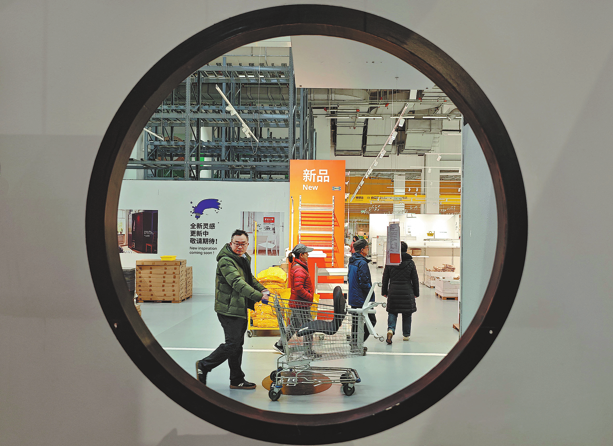
Ikea plans to open about 10 smaller-format stores in China in the next two years as it shifts its focus toward efficiency, local needs and closer links between online and offline retail in one of its most important markets.
The plan is part of a wider effort to reshape its China business for steadier long-term growth, the company said. Instead of expanding rapidly, Ikea is putting more emphasis on compact stores located in urban areas, where customers can shop more frequently and with less travel time. Beijing and Shenzhen, Guangdong province, have been chosen as test markets.
Among the planned openings are a store in Dongguan, Guangdong, scheduled for February 2026 and a Tongzhou store in Beijing set to open in April.
China's well-developed digital retail system plays a key role in Ikea's strategy. The company is working with local partners on digital systems, automation and circular economy projects. These efforts are meant to simplify operations, cut costs and allow the business to respond more quickly and be more focused to changes in demand.
Recent moves show how the strategy is taking shape. Ikea has renovated its Shanghai Xuhui store to combine home inspiration with social spaces; opened five new stores of different sizes across the country; and launched an online flagship store on JD. Together, these steps point to a push to stay closer to consumers in their daily lives, rather than relying mainly on large destination stores.
"China is one of Ikea's most important strategic markets," said Pontus Erntell, president and chief sustainability officer of Ikea China, during a recent interview.
He said the country's large market, strong consumption potential and business environment continue to support Ikea's long-term growth, while also serving as a place to test retail innovation. So far, Ikea China has operated 41 customer-touching points, three operational digital channels and two official stores on e-commerce platforms.
Price remains a key focus. Ikea said that about 160 million yuan ($22 million) investment in fiscal 2026 will be used to lower prices on its best-selling products. The company is also increasing efforts to design products that better match local needs. The retailer plans to introduce more than 1,600 new home products over the coming fiscal year, focusing on "bedroom" and "kitchen".
The shift appears to be supported by traffic data. During fiscal 2025, which runs from September 2024 to August 2025, Ikea China recorded online sales that rose 2 percent, with e-commerce making up 25.7 percent of total revenue.
Ikea's changes reflect broader shifts in how Chinese consumers shop. Faster-paced urban life and widespread digital services are pushing shoppers to value convenience, speed and affordability. Trips to large suburban Ikea stores are no longer a default choice.
Against this backdrop, Ikea said it will close seven large-sized stores starting Feb 2. The closures include locations in Shanghai's Baoshan district, Guangzhou's Panyu district, Tianjin's Zhongbei town, as well as stores in Nantong and Xuzhou of Jiangsu province, Ningbo of Zhejiang province, and Harbin, Heilongjiang province.
Customers in those cities will continue to be served through nearby Ikea stores and digital channels, including its website, app, WeChat mini-program and flagship stores on major e-commerce platforms, said the company.
Beyond retail, Ikea's China strategy also mirrors its moves in commercial real estate and changes at the group level.
In early December, Ingka Centres — part of the Ikea franchisee Ingka Group — said it had partnered with investment firm GoHigh Capital to set up a China-focused real estate fund. The fund will co-own three Livat shopping centers operated by Ingka Centres, located in Wuxi in Jiangsu province, Beijing and Wuhan in Hubei province.
Leadership changes are also underway within the broader Ikea system. Inter Ikea Group said that Jon Abrahamsson Ring will step down after more than 20 years at Ikea, including five years as chief executive. He was succeeded by Jakub Jankowski, effective Jan 1.
wangzhuoqiong@chinadaily.com.cn