



Manufacturing remains backbone of nation's economy









Editor's note: The manufacturing sector will play an important role during the 15th Five-Year Plan (2026-30) period. Wang Minghui, director of the Research Office of the Department of Industrial Economy, which is under the Development Research Center of the State Council, spoke to China Daily about how the sector may evolve over the next five years. Below are excerpts of the interview. The views don't necessarily represent those of China Daily.
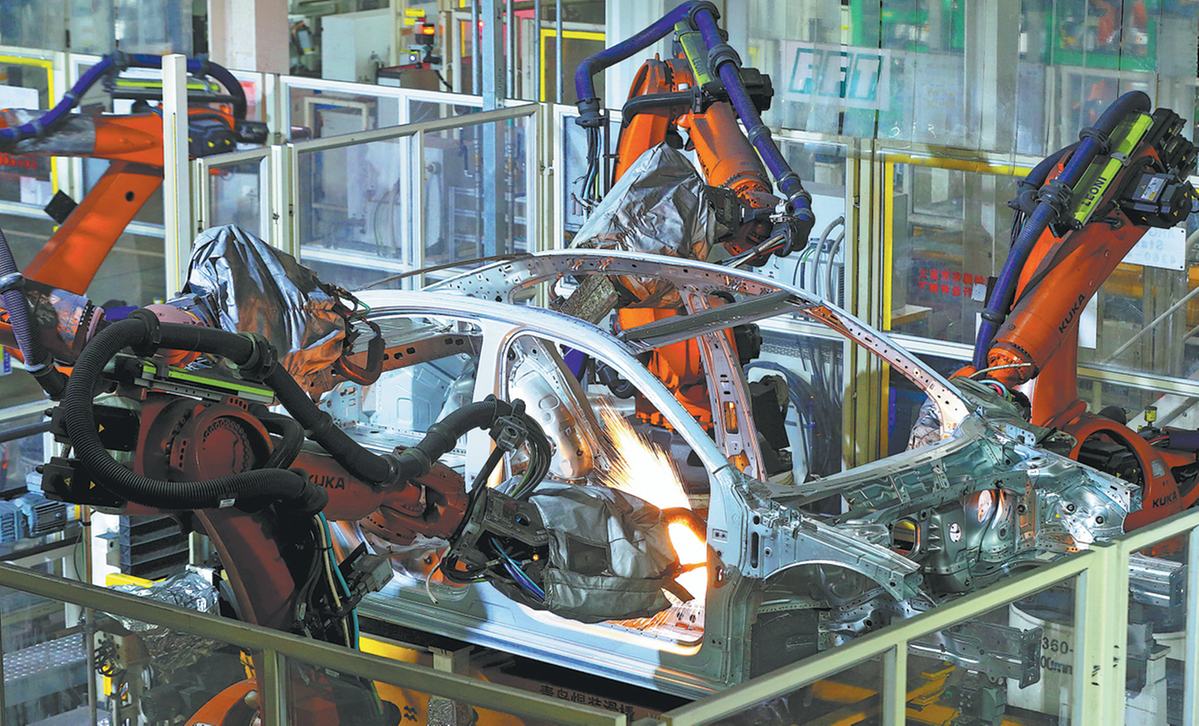
China's advanced manufacturing has registered significant growth in recent years. From 2020 to 2024, the added value of the country's equipment manufacturing industry and high-tech manufacturing industry grew at average annual rates of 7.9 percent and 8.7 percent respectively. China remained the world's largest new energy vehicle producer and seller for the 10th consecutive year in 2024, when it made more than 12.88 million NEVs.
The country's shipbuilding industry also has a large share of the global market. The delivery of the first domestically built large cruise liner Adora Magic City in November 2023 marked a new breakthrough.
China continues to make its industries more eco-friendly and smarter. It has 6,430 "national-level green factories", and more than 40 percent of the companies in the Global Lighthouse Network are Chinese.
These achievements have laid a solid foundation for China to build a modern industrial system with advanced manufacturing as the backbone, and strengthened the country's status and competitiveness in the global division of labor.
China boasts a diverse array of large-scale traditional industries, which enjoy a big market and high output value. Traditional industries, including mining, metallurgy, chemicals, textiles, machinery, shipbuilding and construction are the foundation of China's industrial system and should not be regarded as "low-end industries" that need to be phased out. These traditional industries are expected to make solid contributions to China's growth over the next five years, and the upgrading of these industries will inject new momentum into economic growth.
The country is also accelerating the development of emerging and future industries, including artificial intelligence and the low-altitude economy, where there is huge growth potential.
During the 14th Five-Year Plan (2021-25) period geopolitical conflicts, unilateralism and protectionism challenged the global economy and international trade order. These risks will continue to exist, and could become even more acute during the 15th Five-Year Plan (2026-30) period.
In response, China should enhance the self-reliance of its industry supply chain. For this, it is necessary to further improve the technologies needed by industries that produce high-end computerized machine tools, high-end ships and other important equipment and support major technological breakthroughs. Efforts are needed to mobilize high-quality resources, shore up weaknesses in key technologies and components and achieve breakthroughs in important fields, such as integrated circuits, machine tools, high-end instruments and basic software. The country also needs to diversify the layout of its industry chain, and step up efforts to explore and develop strategic mineral resources.
In recent years, due to rising costs and other factors, some labor-intensive or cost-sensitive industries, such as textiles, apparel and electronic products assembly, have begun to relocate from China to Southeast Asia and other regions. But this will not hollow out China's manufacturing sector, because it enjoys multiple favorable conditions.
First, the country's policymakers place great emphasis on manufacturing. They have made it an important and strategic task to ensure that the sector has an appropriate share of the economy during the 15th Five-Year Plan (2026-30) period. Second, China benefits from its vast market, complete industrial system and rich human resources. It has been the world's largest manufacturer for 15 consecutive years, and has over 600 subindustries. Third, China's economy has a solid foundation. It is highly resilient, and has great potential.





