
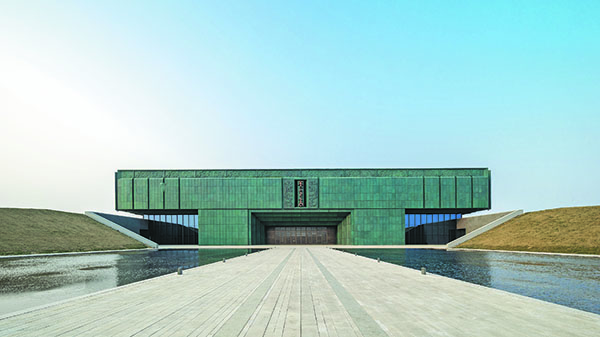
Museum stands as testament to the Shang Dynasty's legacy, Wang Kaihao reports in Anyang, Henan province.
When Di Xin desperately witnessed the defeat of his mighty army to the Zhou people, the last king of the Shang Dynasty (c. 16th — 11th century BC), realizing his fate was sealed, set himself ablaze. His followers surrendered, marking the end of a prosperous kingship.
The people of Shang, also known as the Yin, once proudly referred their capital city in present-day Anyang, Henan province, as Dayishang ("the grand metropolis of Shang"). However, after the upheaval that ended Di Xin's reign, the grand metropolis faded into legend.
In Shiji (Records of the Grand Historian), the monumental book on Chinese history that was compiled about a millennium after the fall of Shang, the place was called Yinxu ("ruins of Yin").
But time blurred a country's collective memory. Hidden beneath the earth, the whereabouts of Yinxu became a mystery. For a long time, if people wanted to glimpse the 500-year-long Shang era, accessible materials were limited: there was just the brief, 2,868-character account on the Shang Dynasty that appeared in Shiji, of which a large part focuses on Di Xin, and a few other fragmented records written long after Shang collapsed.
Amid the aftermath of continuous defeats by invading foreign powers and a deep social crisis in the early 20th century, Chinese people's self-confidence was largely shaken. Many scholars then doubted the credibility of their own past, and tended to believe Shang era only existed in ancient ancestors' imagination rather than actual history.
Fortunately, in 1928, the epoch-defining discovery of the Yinxu Ruins, which spreads across over 30 square kilometers in Anyang, changed everything.
Since then, it has become the longest-studied ancient capital city ruins site in China, and is also honored as one of the cradles of modern Chinese archaeology.