


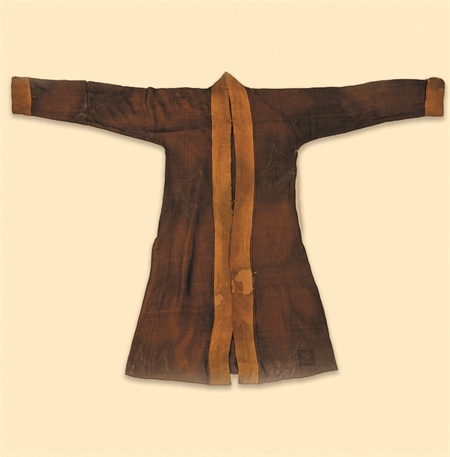
"When the great northern families immigrated to Jiangnan around 317, they took with them their much-valued traditions of painting and calligraphy, of poetry and Buddhism," says Shi Yuan, a researcher from the Shanghai Museum, which owns the partially embroidered piece.
Xie, a patriarch of a prominent family, was a close associate of Wang Xizhi, the single most enshrined calligrapher in Chinese history, whose own uncle, Wang Dao, was a driving force behind the relocation of the Jin court.
When Wang Xizhi gathered his eminent friends for a drinking and poetry writing party in the spring of 353, Xie was invited. The event, taking place amid the beautiful Jiangnan scenery, was immortalized through Wang Xizhi's writing, before being re-imagined in countless paintings for later generations, creating a strong visual bond between the land and the proponents of the country's elite culture.
A capital location
China descended into a state of chaos upon the demise of Eastern Jin in 420, and stayed fragmented until the founding of the Sui Dynasty in 581. The Sui emperors — there were only two of them — oversaw the digging of the Grand Canal, the world's longest artificial waterway which was to run between the modern-day Beijing and Jiangnan city of Hangzhou, Zhejiang province.
"The aim was to facilitate the transportation of men and materials — Jiangnan's rice produce for example — between the south and the north," says Von Spee. More than a millennium later, the same canal would carry the rulers of Qing (1644-1911), China's last feudal dynasty, to Jiangnan, to project their power over the empire's "source of tax and talents" to quote the legendary Qing emperor Kangxi.





