


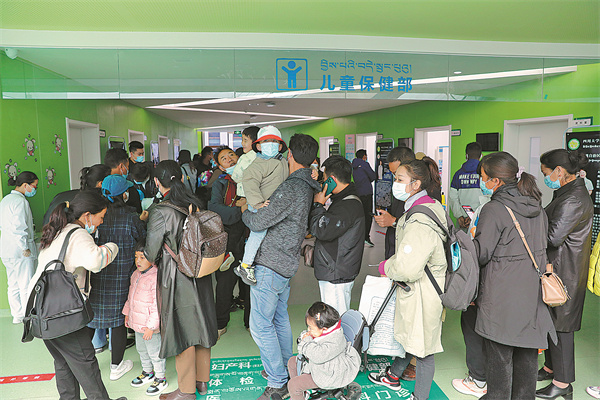
So far, the hospital has launched outpatient services, and set up nucleic acid testing and vaccination centers. Efforts have been stepped up to open inpatient pediatrics, gynecology, obstetrics and neonatal wards, in addition to operating theaters for delivering babies.
Since the Tibetan staff mostly comprises fresh graduates, many have been sent to the West China Second University Hospital for training across disciplines, including rehabilitation and pathology. "Our own team (from Chengdu) trains local doctors on a regular basis," Wang says.
The gaps in medical technology are steadily being narrowed, he says. "Over the next three to five years, we plan to integrate some key disciplines here to promote implementation of internet-based management of maternal and child health," he says.
There have been personal and professional challenges, but Wang and his team are taking it all in their stride. The doctor himself is on anti-hypertensive medication to prevent his blood pressure from flaring up every now and then. "My BP can shoot up to 160/120, which is not a good thing, especially when I am in the middle of a medical consultation. Hence, I take necessary precautions."
Language is also a barrier. Most patients hail from rural, farmers' families and speak only Tibetan. Wang and his team need an interpreter, usually a local colleague, round-the-clock. "We are taking language lessons too," he says.
In the face of adversities, positive feedback from local residents keeps the team going. Wang recalls a conversation with a taxi driver last year. He had asked to be dropped off at a point near the Lhasa cultural and sports center, fearing that the driver would not know about the new hospital. "I was pleasantly surprised when he actually took me to the hospital."
The driver continued to surprise Wang by mentioning that the country had invested more than 1 billion yuan ($141.80 million) to build the hospital and that doctors from Chengdu were coming to run it. "His enthusiasm was inspiring. It has been a constant reminder of the responsibilities we have toward women and children in the region."
The COVID-19 outbreak in Lhasa last month was one of the biggest challenges for Wang and his team. "The clinical lab had to run 24/7.The staff took no breaks and ensured patient care was not compromised," he says.
Wang is among the first batch of 13 doctors and medical management personnel from Sichuan to actually join the aid program in Tibet. "Conventionally, medical aid to Tibet was more like 'blood transfusion'. Experts stayed in Tibet for a year or two and then came back," says Liu Hanmin, director of the Chengdu hospital.
"Things are different now. It is more like 'making blood'. In other words, Tibet is receiving permanent medical technology and management from the West China Second University Hospital," Liu adds.





