


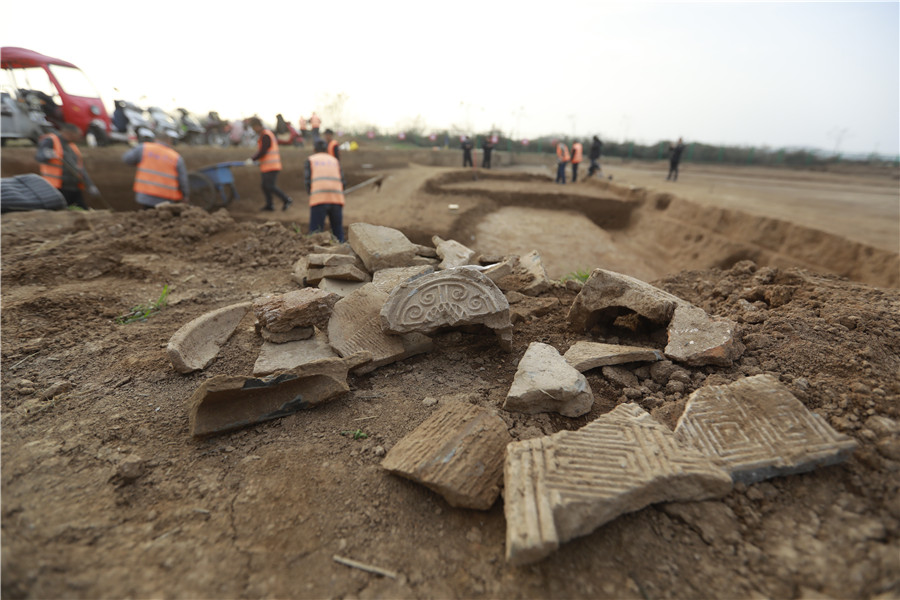
Archaeologists busy at Qin Dynasty location in Shaanxi
On a bleak autumn morning, as archaeologist Zhang Yanglizheng was working at the ruins of the ancient city of Xianyang in Shaanxi province, he uncovered what appeared to be an imperial jade seal protruding from the earth.
"I was excited. We were in the right place. Something interesting had been bound to happen at some stage," said Zhang, 33, from the Shaanxi Academy of Archaeology.
The object dated to the Qin Dynasty (221-206 BC), but it was not an imperial seal because it did not have any inscriptions.
As digging continued, the site was found to be that of a palace where the emperor handled routine affairs and met officials from across the country.
The area, which is covered with loess soil, witnessed the glory days of the Qin Dynasty, the first unified state in Chinese history, and includes the cornerstones and foundations of ancient buildings.
It lies between the modern-day cities of Xi'an and Xianyang on the northern bank of the Weihe River, the largest tributary of the Yellow River in Shaanxi.
Archaeologists started exploring the ruins of Qin Dynasty palaces in the 1950s in an initial push that continued until the 1980s. Researchers from the Shaanxi Academy of Archaeology have been working on the ruins of Xianyang, the dynastic capital, since 2014.
Before deciding on the dig site, they explored an area of more than 5 million square meters.
"It took us two years to find the area of ancient Xianyang where we are now working," Zhang said.
The ancient city was home to palaces, royal storehouses, residential quarters, burial areas and workshops.
"What is interesting is that the past 60 years of archaeological work have failed to unearth the city walls of ancient Xianyang," Zhang said.
"We prefer to believe that Xianyang had no walls, but an explanation is still needed."
At the archaeological work station in the ruins, a black-and-white satellite photo dotted with small flags of various colors hangs on a wall.








