


Policy pays off in stabilizing trade









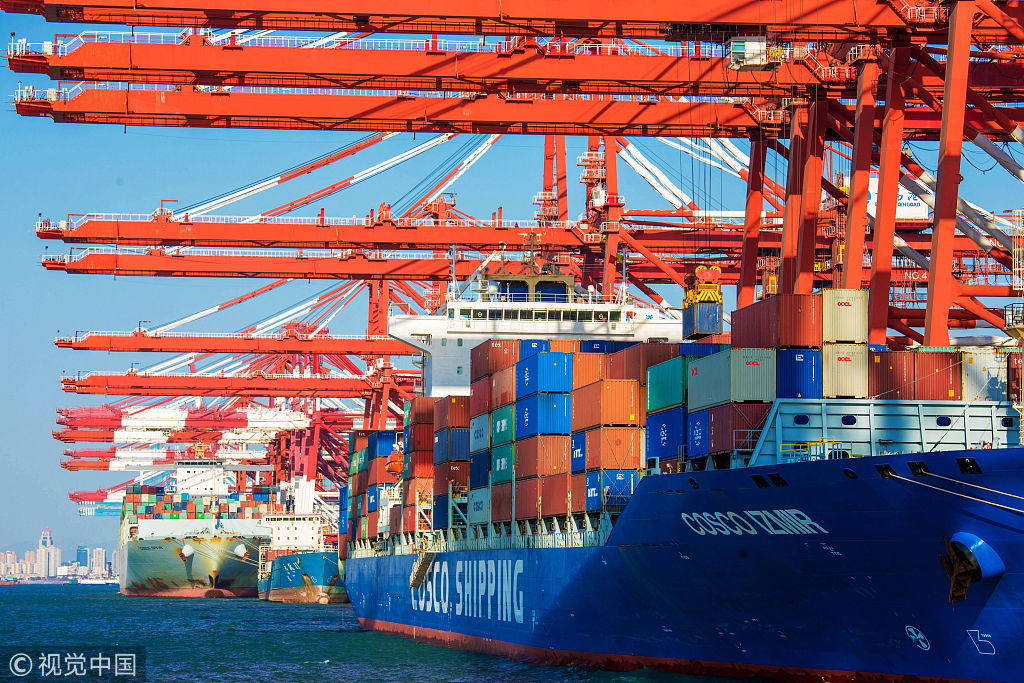
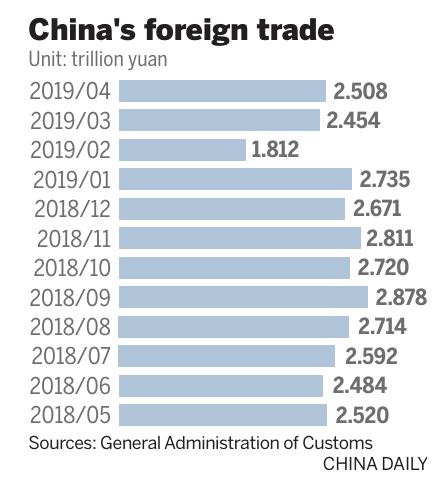
China's total foreign trade rose 4.3 percent year-on-year to 9.51 trillion yuan ($1.41 trillion) in the first four months of the year, showing that the policy of ensuring steady growth of imports and exports has helped stabilize the sector, experts said on Wednesday.
Exports surged 5.7 percent year-on-year to 5.06 trillion yuan, while imports rose 2.9 percent to 4.45 trillion yuan, the General Administration of Customs said on Wednesday.
The trade surplus rose by 31.8 percent to 618.17 billion yuan during the January-April period.
Though China's foreign trade still faces "challenging prospects" as a result of rising protectionism and weak demand this year, the country has significantly enhanced the competitiveness of its exports via technological innovation and increasing added value rather than relying on low cost products, said Li Jian, a senior researcher at the Chinese Academy of International Trade and Economic Cooperation, a think tank under the Ministry of Commerce.
The purchasing managers index, which reflects the vitality of the manufacturing sector, stood at 50.1 in April and 50.5 in March, indicating that business activity in the sector expanded for a second consecutive month, according to the National Bureau of Statistics.
In April alone, trade expanded by 6.5 percent to 2.51 trillion yuan. Exports grew 3.1 percent in yuan terms last month, while imports jumped 10.3 percent, customs data showed.
The trade surplus stood at 93.57 billion yuan in April, down 43.8 percent year-on-year.
Sang Baichuan, director of the Institute of International Economy at the University of International Business and Economics in Beijing, said the fluctuation in exports was caused by a number of factors including seasonality issues and tax reforms.
"The Spring Festival in 2019 was around the same date as in 2011 and 2016. Both 2011 and 2016 produced similar situations as export volume was high in January and March, but low in February," Sang said. "Exports could have been advanced or delayed in February."
He added that the new value-added tax policy took effect in April, and many companies decided to export before April to save on costs.
Liu Yaxin, an analyst at China Merchants Securities, said that apart from domestic economic factors, another reason that imports far exceeded expectations was partially due to soaring imports of crude oil.
China's imports of crude oil and natural gas in the first four months jumped 8.9 percent and 16.4 percent, respectively. The country purchased 340 million metric tons of iron ore during the period.
Trade volume between China and the European Union jumped 11.8 percent, that with ASEAN rose 9 percent, and trade with Japan was 2.1 percent higher year-on-year in the first four months.
China's January-April trade with economies related to the Belt and Road Initiative climbed 9.1 percent year-on-year to 2.73 trillion yuan.