



Study: Insomnia, depression go hand in glove









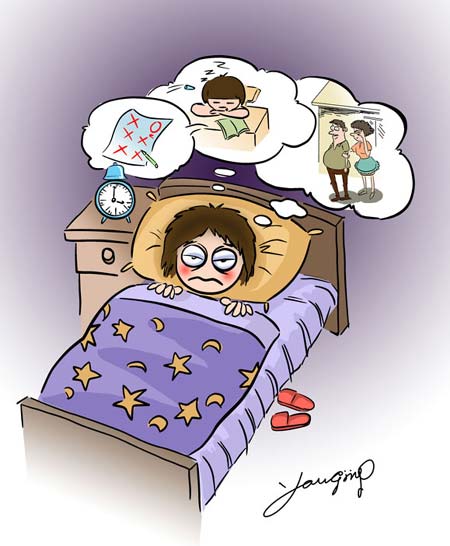
Chinese and British scientists have identified a neural connection between depression and sleep problems, potentially helping health professionals to better understand and treat the conditions.
Researchers at Fudan University in Shanghai and Britain's University of Warwick found a link between the areas of the brain associated with short-term memory and negative emotions that may cause sufferers to dwell on bad thoughts and lead to poor-quality sleep.
"These findings provide a neural basis for understanding how depression relates to poor sleep quality, something that has been observed for more than 100 years," said Feng Jianfeng, head of Fudan University's Institute of Science and Technology for Brain-Inspired Intelligence.
The results of the study, led by Feng and his colleague, Cheng Wei, along with Edmund Rolls from Warwick's Department of Computer Science, were published in the science journal JAMA Psychiatry last week.
"The findings have implications for the treatment of depression and improvement of sleep quality," Feng said.
According to Cheng, depression and sleep problems often go hand-in-hand.
About 75 percent of depressed patients report significant levels of sleep disturbance, such as difficulty falling asleep and short durations of sleep, or insomnia.
People with insomnia also have a higher risk of developing depression and anxiety than those who sleep normally.
The research was launched at Fudan in 2010. Analyzing data from around 10,000 people, the researchers examined the neural mechanisms underlying the relationship between depression and quality of sleep.
In the brains of those living with depressive problems, they discovered a strong connection between the precuneus, an area associated with the self; the lateral orbitofrontal cortex, an area associated with negative emotion; and the dorsolateral prefrontal cortex, an area associated with short-term memory.
"The increased functional connectivity between these brain areas provides a neural basis for how depression is related to poor sleep quality, and results in increased ruminating thoughts that are at least part of the mechanism that impairs sleep quality," Feng said.
"This research could lead to better sleep quality for people with depression, and opens up the possibility of new targeted treatments," he said.


- Hainan's 1st batch of daily consumer goods duty-free shops for island residents opens
- Cross-Strait affairs should be settled 'like family', official says
- Whale injured in collision with fishing boat near Weizhou Island
- Lizard found on high-speed train brought by passenger, rail authorities say
- Zeiss top exec: Learn from China speed
- Ancient tomb cluster in Changsha offers a glimpse into millennia of history











