


World's largest telescope finds new pulsars










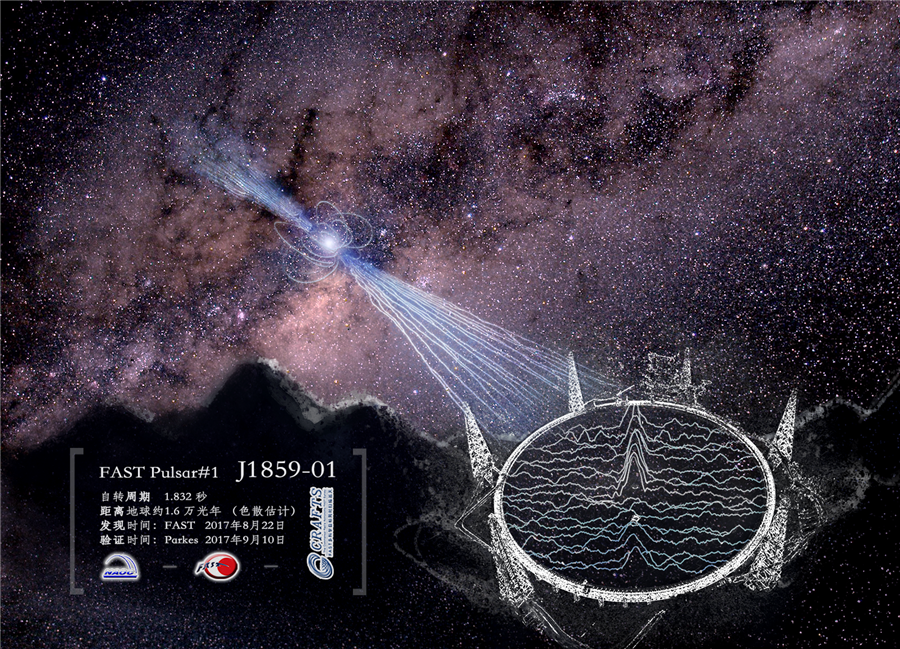 |
| An illustration shows how FAST receives radio waves emitted by distant pulsars, the rapidly rotating cores of dead stars. At left, a photo shows the huge telescope in Guizhou province.[Photo provided to China Daily] |
Chinese researchers have discovered six pulsars, which are superheavy remnants of massive stars, using its Five-hundred-meter Aperture Spherical Radio Telescope, known as FAST.
It is the first time Chinese scientists have discovered pulsars using the world's largest single-dish radio telescope, thus opening a "new era of Chinese original space discovery", Yan Yun, director of the National Astronomical Observatories of China, said on Tuesday.
The first two pulsars, named J1859-01 and J1931-01, were discovered in August and were confirmed in September by the 64-meter radio telescope at Parkes Observatory in Australia.
J1859-01 is 16,000 light years from Earth and rotates once every 1.83 seconds, while J1931-01 is 4,100 light years away and rotates once every 0.59 seconds, according to scientists. Since its completion in September 2016, FAST has discovered two dozen highly possible candidates for pulsars, said Li Di, the telescope's deputy chief engineer.
Last week, FAST also confirmed four new pulsars, but their details are still being analyzed.
"Pulsars are superdense cores of massive stars that went supernova and died, hence they have incredible mass, extremely strong magnetic fields, and they spin like a clock and shoot out strong beams of electromagnetic radiation," Li said.
"The conditions on a pulsar are far more extreme than any lab simulation on Earth. Examining them and seeing how they interact with other stars can help us tackle major scientific issues, such as the origin and evolution of the universe, finding gravitational waves and navigating spacecraft."
Li said FAST is set to be fully operational by the end of 2019. In the meantime, scientists there will continue to test FAST and cooperate with foreign scientists on space exploration.





