



Fruit trees turn wasteland to farmland in Aksu









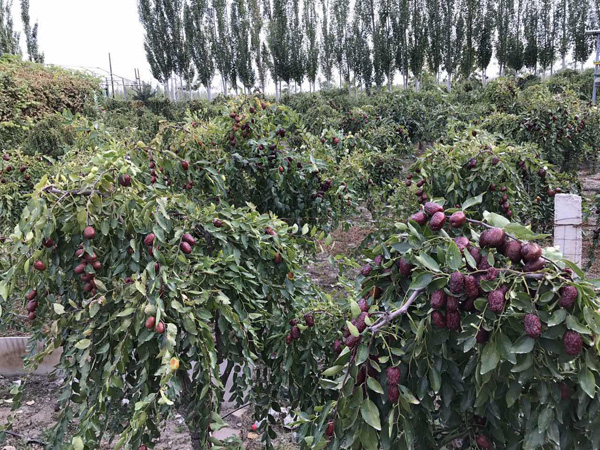 |
| The date trees of the Kekeya green project in Aksu, southern Xinjiang on Sept 21, 2017. [Photo by Liu Wei/chinadaily.com.cn] |
Unlike the common method of protection from sandstorms — picking plants that thrive in the Gobi Desert — Aksu prefecture in southern Xinjiang has chosen fruit trees as the soldiers to protect their locals.
The Kekeya Green Project, started in 1986 by the local government and later joined with other investments, has had a great impact on the local ecology and economy.
The project is located between the north rim of the Taklimakan Desert, the world's second-largest flow desert, and the south of Tomor Peak of Tian Shan Mountain.
"Ten years ago when I came here for the project's fourth stage, it was just endless desert. I couldn't see the road because of the sandstorm," said Deng Hao, head of the forestry bureau of Wensu county in Aksu.
In its first years, the project focused on planting tree species like local aspens and desert date bushes to strengthen the sand and weaken the wind.
It was a huge investment that could hardly be paid off. That's when the trees with economic value became a star.
"When we considered candidates for the green project, we thought about species that can do multiple jobs, both conserving the soil and bringing us economic value," Deng said. "Walnut, dates and apples were our picks. Especially the date trees, they work well with the desert."
From 2006 to 2016, 140,000 acres of fruit trees were planted, which brought the sand down into the ground.
"We haven't had another sandstorm ever since we had this orchard in 2010, only a little sand and dust," Deng said.
Consistent water supply is a must for growing anything on a dead desert. That is another problem.
There's a small river passing through the Gobi — Kekeya river, unable to meet their irrigation needs.


- Jiangsu's Yaohu Town and France's Puy du Fou unveil China's first bird-themed cultural tourism project
- Canadian man praises China's medical efficiency after knee surgery in Yichang
- 30,000 runners compete in cherry blossom-lined Wuhan Marathon
- Wuxi Symphony Hall and Moscow State Tchaikovsky Conservatory ink partnership agreement
- Wuxi Symphony Hall partners with Moscow Conservatory, unveils new music season
- UCLG ASPAC Youth Leaders China Tour kicks off in Suzhou





