Who qualifies
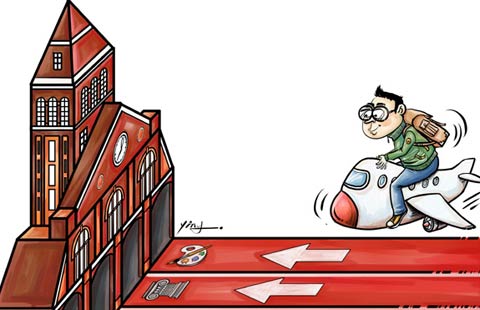
Beijing municipal government's website, www.beijing.gov.cn, says that the only people who can obtain Beijing hukou through legal channels are new college graduates, overseas returnees, people whom the government considers to be "talents" and those who invest at least 8 million yuan to launch a company in Beijing.
Even then, there are further requirements. For example, a new grad must find a job with a national ministry or a State-owned enterprise that has hukou quotas. Competition for such jobs is intense, and the lucky survivors often have to sign a five- or 10-year contract with a high penalty for breaking it.
Marrying a Beijinger can be an easy way to get a hukou, but it requires navigating various requirements including age and location. But in most cases, the couple must be married at least five years before the non-resident partner receives hukou.
A ranking system
In a bid to improve the hukou system, the city proposes to introduce a grading system for applicants, ranking them on such criteria as professional skills, contribution to the city, tax paid and how long they have lived in Beijing. Those who reach the standards will be given hukou.
"The government must make sure that the criteria are carried out in a scientific, objective, measurable, transparent way and that the result is open to the public," said Hu Xingdou, an economics professor at the Beijing Institute of Technology.
In June 2010, Guangdong province launched the country's first grading system for non-locals. More than 100,000 migrant workers have since acquired hukou in Guangdong's urban areas.
"Of course, the trade of hukou is illegal," Hu said. "Government and related administrative departments need to take harsh measures to curb the trade."
Yuan Xin, the Naikai professor, noted that no specific governmental agency has oversight of the hukou system, so "it's very hard to supervise this trade".
Hu said the fundamental reason for the illegal trade still lies in the unequal distribution of economic benefits and public resources."
Hu said Beijing is considered to be a privileged city, for it is the political, economic and cultural center of China, and it has most of the country's top hospitals, medical staff, universities, scholars, central government bodies, and the majority of China headquarters for multinational companies.
This unequal investment widens the gap between Beijing and other places, he said. Similar disparities exist in some developed countries, such as the United States, but residency there is restricted by economics rather than public policy.
"It's a problem left over from history," Hu said. "It cannot be solved in a short time, but there is still room to improve. . . . To apply an access system in Beijing, the grading system should be carried out not only among top-level talents, but also migrant workers and those who live at the bottom of society, so all walks of society can share the opportunity to be a Beijinger one day."


Copyright 1995 - . All rights reserved. The content (including but not limited to text, photo, multimedia information, etc) published in this site belongs to China Daily Information Co (CDIC). Without written authorization from CDIC, such content shall not be republished or used in any form. Note: Browsers with 1024*768 or higher resolution are suggested for this site.
License for publishing multimedia online 0108263 Registration Number: 130349